
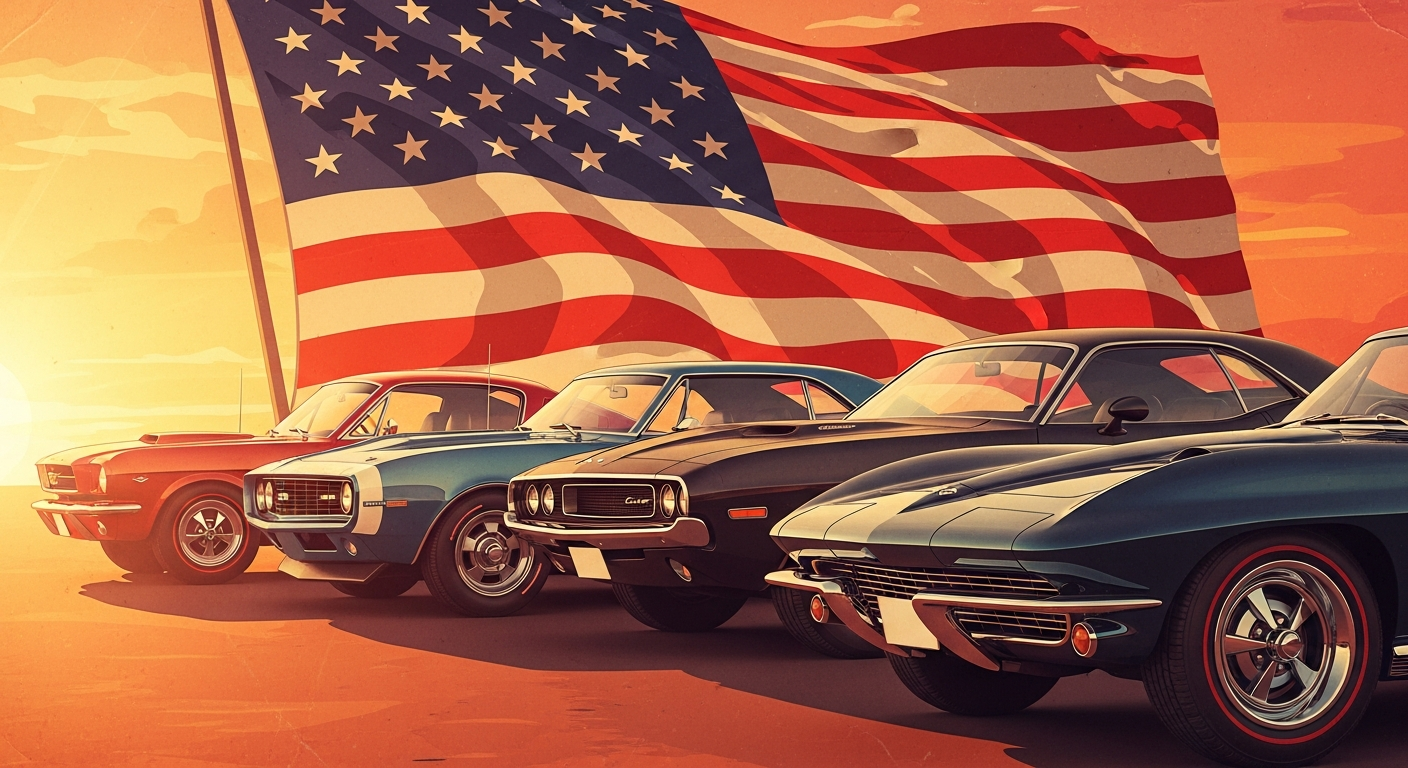
Amerikanische Autos – or American cars – hold a special place in Germany's automotive culture. While Germany is home to BMW, Mercedes, and Porsche, there's a growing community of enthusiasts who are captivated by the raw power, unmistakable sound, and bold styling of US cars. The appeal is simple: nothing in Europe sounds like a 5.0-liter V8 Ford Mustang at full throttle. Nothing looks like a Dodge Challenger rolling down the Autobahn. And nothing delivers the same visceral driving experience as a Chevrolet Corvette on a winding country road. The US car scene in Germany has exploded over the past decade. Registration numbers for American vehicles have risen steadily, US car meets attract thousands of visitors, and specialized workshops like Gatran Garage are busier than ever. Whether it's a classic muscle car from the 1960s or a brand-new Mustang GT – the fascination with American automotive engineering transcends generations. But what makes these cars so special? Which models are the most popular? And what do you need to know before buying one in Germany? This comprehensive guide answers all these questions.
The Big Three: Ford, Chevrolet & Dodge
The American automotive industry is dominated by three legendary manufacturers – the so-called "Big Three." Each brand has its own character, its own philosophy, and its own loyal following in Germany. Understanding these brands is the first step to understanding why American cars are so different from their European counterparts.
Ford
Ford is arguably the most recognized American brand in Germany. Founded by Henry Ford in 1903, the company revolutionized the automotive industry with the assembly line. In Germany, Ford is known primarily for the Mustang – the most successful sports car of all time with over 10 million units sold. The F-150 pickup, America's bestselling vehicle for over 40 years, is also gaining traction on German roads. Ford's philosophy has always been about making performance accessible to the average person – and that resonates deeply with German car culture.
- Top models: Mustang, F-150, Bronco, GT
- Founded: 1903, Detroit
- Known for: Coyote V8, accessibility
Chevrolet
Chevrolet – or simply Chevy – represents the heartbeat of America. Founded in 1911 by Louis Chevrolet and William C. Durant, the brand has produced some of the most iconic vehicles in automotive history. The Corvette, America's sports car since 1953, is a legend that rivals European supercars at a fraction of the price. The Camaro, born in 1966 as the direct answer to Ford's Mustang, has become a cult car in its own right. The brand's Small Block V8 engine is considered one of the greatest engines ever built – reliable, powerful, and endlessly tunable.
- Top models: Corvette, Camaro, Silverado, Bel Air
- Founded: 1911, Detroit
- Known for: Small Block V8, Corvette
Dodge / RAM
Dodge is the rebel of the Big Three. While Ford and Chevrolet play it relatively safe, Dodge has always pushed boundaries – building cars that are louder, faster, and more aggressive than the competition. The HEMI V8 engine is legendary: from the original 426 HEMI of the 1960s to the modern 6.2-liter supercharged Hellcat producing 717 hp. The Challenger and Charger are the last of the true American muscle cars – massive, powerful, and unapologetically loud. RAM, now a separate brand, dominates the pickup truck segment with the RAM 1500 becoming increasingly popular in Germany.
- Top models: Challenger, Charger, RAM 1500, Viper
- Founded: 1900, Detroit
- Known for: HEMI V8, Hellcat
The Most Popular US Cars in Germany
Some American cars have achieved true icon status in Germany. These are the models you'll see at every US car meet, the ones that generate the most search queries, and the ones our workshop handles most frequently. Here's an in-depth look at Germany's favorite American automobiles.
1. Ford Mustang – The Undisputed King
The Ford Mustang is the most popular American car in Germany – by a wide margin. Since its debut in 1964, the Mustang has defined what an affordable sports car should be. In Germany, you'll find every generation represented: from pristine first-generation Fastbacks (1964-1973) worth €50,000+ to daily-driven sixth-generation GTs that start around €40,000 new. The current seventh generation (S650, from 2024) continues the tradition with a naturally aspirated 5.0-liter Coyote V8 producing 450 hp. What makes the Mustang special in Germany is the 2015 decision by Ford to offer it with right-hand traffic configuration and European type approval – making it the first Mustang you could buy directly at a Ford dealer in Germany. This dramatically boosted sales and created a new generation of Mustang fans who might never have considered an import.
2. Chevrolet Corvette – America's Sports Car
The Corvette has been America's answer to European sports cars since 1953. In Germany, the Corvette enjoys a dedicated following that appreciates its unique combination of brutal performance and relative affordability. The C2 Stingray (1963-1967) is a Holy Grail for collectors, commanding prices of €100,000-300,000 for pristine examples. The C3 (1968-1982) with its Coke-bottle shape is the classic cruiser. But it's the modern C8 (from 2020) that has turned heads worldwide: a mid-engine layout, 6.2-liter V8 with 495 hp, and a 0-100 km/h time of 2.9 seconds. In the USA, the C8 starts at around $65,000 – in Germany, dealers charge well over €100,000, making a direct import extremely attractive.
3. Dodge Challenger & Charger – Modern Muscle
The Dodge Challenger is the last of the old-school muscle cars. While Ford and Chevrolet modernized their designs, the Challenger (2008-2023) stayed true to its 1970 roots with a massive, aggressive body that looks like nothing else on the road. The HEMI V8 engine lineup is staggering: from the 375 hp 5.7-liter R/T to the absolutely insane 6.2-liter supercharged Hellcat with 717 hp – and the limited Demon 170 producing 1,025 hp, making it the most powerful production car ever built. The Charger, its four-door sibling, offers the same powertrains in a practical sedan body. In Germany, the Challenger has a cult following. With production ending in 2023, prices for well-specced examples are rising, and the Hellcat variants are already becoming collector's items. Expect to pay €60,000-80,000 for a used Hellcat, with Demon models commanding €150,000+.
4. Chevrolet Camaro – The Eternal Rival
The Camaro was born in 1966 for one reason: to beat the Mustang. And for nearly 60 years, these two have battled for supremacy in the pony car segment. In Germany, the Camaro enjoys strong popularity, particularly the fifth generation (2010-2015) which became a Hollywood star in the Transformers franchise. The sixth generation (2016-2024) brought refined handling with the Alpha platform and the mighty ZL1 variant with a supercharged 6.2-liter V8 producing 650 hp. With 2024 being the final production year for the Camaro, values are climbing. A well-maintained sixth-gen SS with the 6.2-liter V8 (455 hp) can be found for €35,000-50,000 in Germany. The first generation (1967-1969) is a collector's dream, with numbers-matching SS or Z/28 models reaching €80,000-150,000 depending on condition and documentation.
5. Pickup Trucks: RAM 1500 & Ford F-150
Full-size pickup trucks are the fastest-growing segment of American vehicles in Germany. The RAM 1500 with its 5.7-liter HEMI V8 (400 hp) has become the truck of choice for German buyers, offering a combination of luxury interior, powerful engine, and imposing presence that no European vehicle can match. The Ford F-150, America's bestselling vehicle for over four decades, is also gaining ground – particularly the Raptor variant with its twin-turbo 3.5-liter V6 producing 450 hp, designed for off-road supremacy. Why are Germans buying trucks? Families appreciate the space and safety. Business owners love the utility. And everyone enjoys the commanding driving position and the sheer presence of a vehicle that dwarfs everything else on the road. Prices in Germany start at around €55,000 for a well-equipped RAM 1500 and can easily exceed €90,000 for loaded Limited or TRX models with the 702 hp supercharged HEMI.
Why US Cars Are So Different
The differences between American and European cars go far beyond engine size. They reflect fundamentally different philosophies of what a car should be and how it should make you feel.
The V8 Sound
There's nothing like it. The deep, rumbling idle of a big-displacement V8 is visceral and emotional in a way that turbocharged four-cylinders simply cannot replicate. A Ford Mustang GT with its 5.0-liter Coyote V8 produces a sound that turns heads everywhere – from supermarket parking lots to the Nürburgring. This is the primary reason most buyers cite for choosing an American car: the sound. It's not just about performance numbers; it's about how the car makes you FEEL.
Size and Comfort
American cars are built for a country with wide roads and long distances. That translates into spacious interiors, comfortable suspension, and a relaxed driving experience. A RAM 1500 crew cab offers more legroom than most luxury sedans. A Mustang's trunk can swallow a full set of golf clubs. The seats are designed for hours of comfortable cruising. This focus on comfort over sportiness is a refreshing contrast to the often firm, performance-oriented European approach.
Styling Philosophy
While European design often prioritizes aerodynamic efficiency and subtle elegance, American car design is bold and emotional. The Dodge Challenger's retro-inspired lines are a direct homage to the 1970 original. The Corvette C8's aggressive mid-engine stance screams supercar. Even modern trucks like the RAM 1500 have a design presence that demands attention. American cars don't try to blend in – they're designed to stand out, and that's exactly what German enthusiasts love about them.
Price-Performance Ratio
This is where American cars truly shine. A Ford Mustang GT with 450 hp costs around €40,000 – for comparable performance from a German manufacturer, you'd pay €70,000-90,000. A Corvette C8 with supercar-level performance starts at €65,000 in the USA, while a Porsche 911 Carrera S costs nearly twice as much. Even at German dealer prices with markup, American performance cars offer significantly more horsepower per euro than their European rivals. For many buyers, this value proposition is irresistible.
Buying US Cars in Germany: What You Need to Know
Owning an American car in Germany is an incredible experience – but it comes with specific considerations that you should understand before making a purchase. Here's what you need to know.
Important: TÜV Requirements for US Cars
US cars that were not sold through official European channels require a Vollabnahme (full inspection) according to §21 StVZO. This includes conversion of headlights from US to EU standard, speedometer calibration from mph to km/h, rear fog light installation, and potentially exhaust modifications. Budget €1,000-3,000 for these conversions. Cars bought from an official German Ford/Chevrolet dealer already meet EU standards.
Insurance Considerations
Insurance for American cars in Germany is generally higher than for comparable European vehicles – but it's not as extreme as many fear. A Ford Mustang GT (S550/S650) typically falls into Typklasse 20-22 for liability and 25-27 for comprehensive coverage. Annual costs for a 30-year-old driver with SF12 (claim-free class) run between €800-1,500 per year for full coverage. Classic cars registered with H-plates (Oldtimer) benefit from flat-rate insurance starting at around €200 per year. Seasonal plates (Saisonkennzeichen) can reduce premiums by 30-40% if you only drive April through October. Tip: Specialist insurers like OCC or American Car Classics often offer better rates than general providers.
Fuel Costs and Consumption
Let's be honest: V8s drink fuel. A Ford Mustang GT consumes around 12-14 liters per 100 km in mixed driving, rising to 18-20 liters in spirited driving. A Dodge Challenger Hellcat can easily consume 16-20 liters in normal use. Pickup trucks like the RAM 1500 average 14-16 liters. At German fuel prices of approximately €1.80 per liter Super Plus, that translates to €22-36 per 100 km. However, modern American engines are more efficient than their reputation suggests. The 10-speed automatic in the current Mustang achieves highway figures of 8-9 liters per 100 km at moderate speeds. Many owners consider the fuel costs a worthwhile trade-off for the driving experience – and most US cars run happily on Super (95 octane), not requiring the more expensive Super Plus.
Spare Parts Availability
One of the biggest advantages of American cars is the excellent spare parts supply. The US aftermarket industry is enormous – companies like AutoZone, RockAuto, and Summit Racing offer parts for virtually every American car ever made, often at prices significantly lower than European equivalents. Shipping from the USA takes 7-14 days and customs on parts under €150 is generally duty-free. For current models like the Mustang or Corvette, Ford and Chevrolet's European dealer networks stock most common service parts. Classic car parts for Mustangs, Camaros, and Corvettes are abundantly available through specialists like CJ Pony Parts, Year One, or Eckler's. German specialists like Gatran Garage maintain comprehensive stock of common wear parts for popular US models.
Common Pitfalls When Buying
The US Car Scene in Germany
Germany has one of the largest and most active US car communities in Europe. Every year, hundreds of US Car Treffen (meets) take place across the country, from small local gatherings of 20-30 cars to massive events like Street Mag Show with over 5,000 vehicles. These events are more than just car shows – they're celebrations of American culture, complete with BBQ, live music, and a relaxed atmosphere that brings together enthusiasts from all walks of life. Clubs like the Mustang Club of Germany, the Corvette Club Deutschland, and countless regional US car clubs provide a sense of community and shared passion. Online forums and social media groups have made it easier than ever to connect with fellow enthusiasts, find parts, and get advice on maintenance and modifications.
At Gatran Garage, we're proud to be part of this community. Our annual US Car Treffen in Wimsheim has grown into one of the most popular events in the Stuttgart region, attracting hundreds of American vehicles and thousands of visitors. The trend is clear: the US car scene in Germany is growing year after year, with younger enthusiasts joining the ranks and new models like the Mustang GT and RAM 1500 making American cars more accessible than ever. Whether you're a seasoned collector with a garage full of classics or someone considering their first Mustang – there's a place for you in the German US car community.
Your US Car Partner in Southern Germany
Whether you need professional service for your Mustang, expert restoration for your classic Corvette, safe winter storage for your Challenger, or TÜV conversion for a freshly imported vehicle – Gatran Garage in Wimsheim near Stuttgart is your specialized workshop for all American cars.