
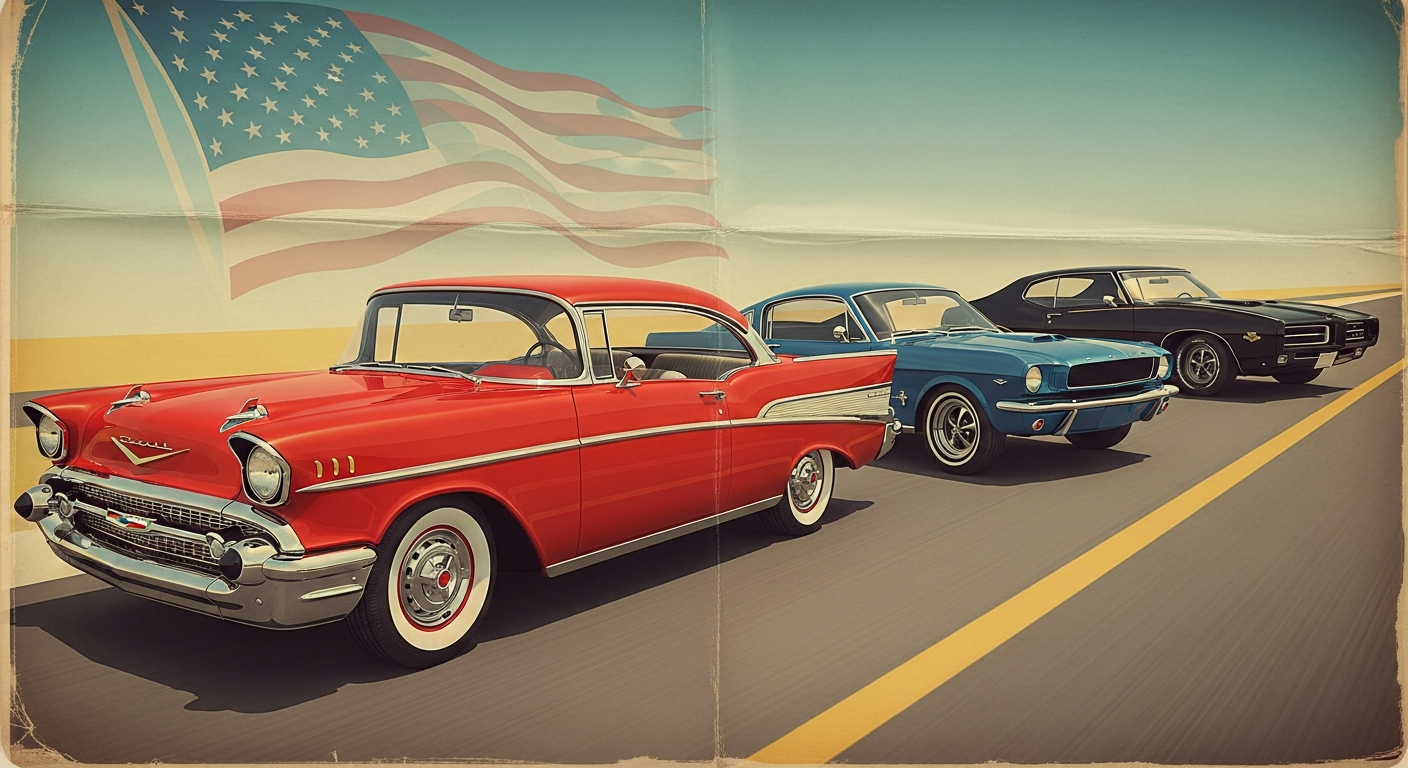
There's a reason why the words "American Classic Car" instantly conjure images of chrome-laden fins, rumbling V8 engines, and endless highways stretching through the desert. Between the late 1940s and the early 1970s, American automakers created some of the most iconic, powerful, and culturally significant automobiles ever built. These weren't just cars – they were symbols of freedom, prosperity, and the American Dream itself. The 1957 Chevrolet Bel Air with its soaring tail fins became the poster child of 1950s optimism. The Ford Mustang, launched in April 1964, single-handedly invented the "pony car" segment and sold over one million units in its first two years. The Dodge Charger R/T and Plymouth Barracuda fueled the muscle car wars of the late 1960s, producing street-legal vehicles with 400+ horsepower that could outrun anything on the road. Hollywood cemented their legend: Steve McQueen's Mustang GT in Bullitt (1968), the General Lee Charger in The Dukes of Hazzard, and Dom Toretto's Charger in Fast & Furious turned these machines into cultural icons that transcend generations. Today, the collector market for American classics is booming – particularly in Germany, where a passionate community of US car enthusiasts has been growing steadily. Prices for top-condition examples have risen by 40-80% over the past decade, and rare models like the Hemi Cuda or Boss 429 Mustang have crossed into seven-figure territory. This guide covers the ten most legendary American classic cars, their current market values, what restoration really costs, and whether they make sense as investments.
The Golden Era: 1950s to 1970s
The story of American classic cars begins in the aftermath of World War II. With the war economy transitioning to consumer goods, American automakers had the largest industrial capacity in the world – and a booming middle class eager to spend. The automobile became the ultimate status symbol, and Detroit's Big Three – General Motors, Ford, and Chrysler – competed fiercely for every dollar.
The Post-War Revolution
The first completely new post-war designs appear. Harley Earl at GM revolutionizes car design with panoramic windshields, two-tone paint, and the first tail fins inspired by the P-38 Lightning fighter aircraft. The Chevrolet V8 Small Block debuts in 1955 – an engine that will change the world. Ford counters with the Thunderbird as a 'personal luxury car'.
Chrome, Fins & Exuberance
Tail fins grow ever larger, cars ever wider, chrome ever shinier. In 1957, the Chevrolet Bel Air reaches its iconic peak. The 1959 Cadillac Eldorado wears the tallest tail fins in automotive history. V8 engines become standard, air conditioning and power steering spread. The Interstate Highways are built – America becomes a car nation.
Birth of the Muscle Cars
In 1964, the Pontiac GTO defines the formula: mid-size car + big engine = muscle car. Ford launches the Mustang and sells 22,000 on the first day. Chevrolet responds with the Camaro, Plymouth with the Barracuda. The horsepower war begins – every manufacturer wants the most powerful engine in the catalog. The insurance industry looks the other way.
The Absolute Peak
The golden years of muscle cars. Engines reach 425-450 HP from the factory – and often significantly more in reality. The 1969 Dodge Charger R/T, the Chevrolet Camaro Z28, the Corvette Stingray, and the legendary Plymouth Hemi Cuda are born. NASCAR and Trans-Am racing drive development. Drag racing becomes a national pastime. It is the most intense period in automotive history.
The End of an Era
The 1973 oil crisis hits muscle cars like a hammer. Rising insurance premiums, new emissions regulations (Clean Air Act), and fuel shortages end the era abruptly. Compression ratios drop, power falls by 30-50%. The 1971 Mustang has already grown massively and lost its sporty character. GM limits all engines to a maximum of 400 cubic inches. The era of pure performance is over – but the legend lives on.
The 10 Most Legendary American Classic Cars
These are the cars that defined an era, shaped pop culture, and are now among the most sought-after collector vehicles in the world. Current market values reflect European prices for good to excellent condition examples.
1957 Chevrolet Bel Air
The 1957 Chevrolet Bel Air is arguably the most recognizable car of the 1950s. Its dramatic tail fins, chrome-laden body, and distinctive two-tone paint schemes made it the ultimate expression of post-war American optimism. Under the hood, the 283 cubic inch (4.6L) Small Block V8 produced up to 283 HP with fuel injection – the first production engine to achieve one horsepower per cubic inch. General Motors sold over 1.5 million Bel Airs in 1957, making it a massive commercial success. Today, it remains one of the most popular classic cars at shows and cruises worldwide. The parts supply is excellent due to high production numbers, making restoration relatively straightforward. Convertible models command a significant premium, with pristine examples reaching €120,000+.
1964½ Ford Mustang
The car that started it all. When Ford unveiled the Mustang at the 1964 New York World's Fair on April 17, it caused a sensation unlike anything the auto industry had seen. Lee Iacocca's vision of a compact, sporty, affordable car resonated so deeply that Ford sold 22,000 units on the first day and over 418,000 in the first year. The initial engine lineup ranged from a modest 170ci inline-six (101 HP) to the potent 289ci V8 (271 HP). The Mustang created the "pony car" segment and forced every competitor to respond – Chevrolet with the Camaro, Plymouth with the Barracuda, Pontiac with the Firebird. Early Mustangs are among the best-supported classics for restoration, with virtually every part available as reproduction. K-Code (High Performance 289) models and convertibles are the most valuable.
1969 Dodge Charger R/T
Perhaps no American car has more screen presence than the 1969 Dodge Charger R/T. Its aggressive fastback design, hidden headlights, and muscular proportions made it the definitive muscle car silhouette. The R/T ("Road/Track") package came standard with the legendary 440ci Magnum V8 (375 HP), with the optional 426ci Hemi producing 425 HP – figures that were famously underrated by Chrysler. The Charger became a pop culture icon through the Steve McQueen film Bullitt (1968), as the General Lee in The Dukes of Hazzard (1979-1985), and in the Fast & Furious franchise. 426 Hemi-equipped Chargers are extremely rare and can command €200,000+. Even standard 440 models have seen dramatic value increases over the past decade. Rust is the primary concern for restoration – particularly in the trunk floor, quarter panels, and lower fenders.
1963 Corvette Stingray Split-Window
The 1963 Corvette Stingray C2 is widely considered the most beautiful American sports car ever made. Designed by Larry Shinoda under Bill Mitchell's direction, the Split-Window Coupe was produced for only one year – 1963 – before Zora Arkus-Duntov insisted on removing the central spine for better rear visibility in 1964. This single-year production makes it one of the most collectible Corvettes in existence. The top engine option was the 327ci V8 with fuel injection, producing 360 HP. Only 10,594 coupes were built in 1963, and the fuel-injected versions are among the rarest. The fiberglass body doesn't rust, but the steel frame certainly does, and parts for the unique split-window coupe are expensive. Matching-numbers examples with documentation routinely sell for €150,000-250,000 at auction.
1969 Chevrolet Camaro Z28
The Z28 was born for one reason: to win the Trans-Am racing series. SCCA rules required a production version of any race car, so Chevrolet created the Z28 with a high-revving 302ci small block V8 (290 HP official, closer to 350 HP in reality), heavy-duty suspension, front disc brakes, and a Muncie 4-speed manual. The 1969 model year is the most desirable, featuring the iconic shark-body styling with cowl-induction hood, bold racing stripes, and aggressive stance. Only 19,014 Z28s were built in 1969. On the track, drivers like Mark Donohue dominated Trans-Am with the Camaro, winning the championship in 1968 and 1969. The Z28's combination of race heritage, stunning looks, and limited production makes it one of the most sought-after first-gen Camaros. Cross-Ram intake versions are particularly rare and valuable.
1970 Plymouth Barracuda (Hemi Cuda)
The 1970 Plymouth Hemi Cuda is the holy grail of muscle cars. When Plymouth redesigned the Barracuda for 1970 on the new E-body platform, they created one of the most aggressive-looking cars of the era. The Hemi Cuda package combined the brutal 426ci Hemi V8 (425 HP) with "Shaker" hood scoop, heavy-duty everything, and wild factory colors like "Lemon Twist," "In-Violet," and "Tor-Red." Here's what makes it so valuable: only 652 Hemi Cudas were built in 1970, and of those, only 14 were convertibles. A Hemi Cuda convertible sold at Mecum Auctions in 2014 for $3.5 million. Even hardtop versions regularly sell for $200,000-500,000. Restoration is extremely difficult because Hemi-specific parts are rare and expensive, and authentication of genuine Hemi cars is critical – the value difference between a real Hemi and a clone is enormous.
1964 Pontiac GTO
The car that started the muscle car revolution. The 1964 Pontiac GTO was the brainchild of John DeLorean, Jim Wangers, and Bill Collins, who circumvented GM's corporate ban on engines larger than 330ci in intermediate cars by offering the 389ci V8 (325-348 HP) as an option package on the Tempest. The name "GTO" was borrowed from the Ferrari 250 GTO – a move that infuriated Enzo Ferrari. Originally planned for 5,000 units, Pontiac sold 32,450 GTOs in 1964, proving that there was massive demand for affordable performance. The GTO's success convinced every Detroit manufacturer to build their own muscle car, launching an entire era. Tri-Power (three two-barrel carburetors) versions are the most collectible, and fully documented early GTOs continue to appreciate in value.
1969 Ford Mustang Boss 429
The Boss 429 exists for one reason: NASCAR homologation. Ford needed to produce 500 street versions of its new 429ci semi-hemispherical combustion chamber engine to qualify it for NASCAR racing. The engine was so massive that it wouldn't fit in the Mustang's engine bay without extensive modifications – the shock towers had to be moved, and installation was outsourced to Kar Kraft in Brighton, Michigan. The official rating was 375 HP, but insiders know the real output was closer to 500 HP. Only 859 Boss 429s were produced in 1969 and 499 in 1970. Each car was hand-assembled and individually numbered. The combination of NASCAR heritage, extreme rarity, and the massive "Shotgun" engine makes the Boss 429 one of the most valuable Mustangs ever built. Kar Kraft serial numbers and matching engine stamps are critical for authentication.
1970 Chevrolet Chevelle SS 454
The 1970 Chevelle SS 454 represents the absolute peak of the Big Block muscle car era. The LS6 454ci (7.4L) engine produced a factory-rated 450 HP and 500 lb-ft of torque – numbers that were almost certainly conservative. The LS6 was one of the highest-output production engines ever offered by General Motors. With a solid-lifter camshaft, 11.25:1 compression ratio, and 800 CFM Holley carburetor, it was essentially a race engine in a street car. The 1970 Chevelle SS with the LS6 option could run the quarter mile in the low 13-second range straight from the factory. Only 4,475 LS6 Chevelles were produced in 1970, making them highly collectible. The more common LS5 (360 HP) version is more affordable but still commanding respect. Restoration is manageable due to the large number of A-body Chevelles produced, though LS6-specific components are premium-priced.
1957 Ford Thunderbird
The 1957 Ford Thunderbird was the last of the two-seat "personal luxury car" Thunderbirds before Ford enlarged it to a four-seater in 1958. The 1955-1957 T-Birds are the most desirable generation, and the 1957 model is the pinnacle thanks to its distinctive porthole hardtop, larger fins, and bumper-mounted spare tire. Power came from a 312ci Y-block V8 producing up to 300 HP with optional supercharger. Ford sold 21,380 Thunderbirds in 1957 – a strong number, but far fewer than the Corvette's competitor status would suggest. The T-Bird wasn't meant to be a sports car; it was a boulevard cruiser with style and comfort. Restoration is relatively straightforward due to strong parts support from multiple suppliers. Supercharged "F-Code" models are the rarest and most valuable, reaching €100,000+ in pristine condition.
Value Trends: US Classic Cars as Investment
The American classic car market has shown remarkable growth over the past decade. According to the Hagerty Price Guide and auction results from Barrett-Jackson, Mecum, and Bonhams, top-tier muscle cars have appreciated by 40-80% since 2015. The Hemi Cuda convertible market has seen the most dramatic increases, with values tripling in some cases. Even more affordable entry-level classics like the Ford Mustang coupe and Chevrolet Bel Air have shown steady 5-8% annual appreciation – outperforming many traditional investment vehicles.
Top Appreciating Models (2015-2025)
- Plymouth Hemi Cuda: +120-200%
- Boss 429 Mustang: +80-150%
- 1969 Camaro Z28: +60-90%
- 1963 Corvette Split-Window: +50-70%
- 1969 Charger R/T Hemi: +70-100%
Value Factors
- Matching Numbers: Original engine/transmission = 30-50% premium
- Documentation: Build sheet, window sticker, dealer invoice
- Originality: Unrestored survivors can exceed restored values
- Provenance: Known history and celebrity ownership
However, investing in classic cars comes with significant risks. Storage costs, insurance, maintenance, and potential depreciation must be factored in. Not every classic car appreciates – only the most desirable models in excellent condition with proper documentation see consistent gains. Common models in average condition may stagnate or even lose value when adjusted for inflation. The market is also cyclical: economic downturns can temporarily reduce values by 10-20%. The best strategy is to buy what you love, maintain it properly, and enjoy driving it – any appreciation should be considered a bonus, not a guarantee.
Restoration: What It Really Costs
Restoring an American classic car is a labor of love – and it's rarely cheap. The romanticism of finding a barn find and bringing it back to glory sounds wonderful, but the financial reality can be sobering. The costs vary depending on the vehicle and condition – from partial restorations to complete frame-off rebuilds, every project is unique. High-end concours restorations for rare models like the Hemi Cuda or Boss 429 require particularly intensive work. → Request individual quote
Warning: Hidden Restoration Costs
The #1 rule of classic car restoration: The car will ALWAYS cost more than you planned. Hidden rust, incorrect previous repairs, missing parts, and unexpected mechanical issues can easily double the initial estimate. Budget at least 30% more than quoted. Many restoration projects are abandoned halfway because the owner runs out of money. Start with a realistic assessment, get a professional inspection BEFORE buying, and have a financial buffer.
Restoration Costs
Every restoration project is unique – costs depend on the vehicle model, condition, scope of work, and desired quality level. We provide transparent, detailed estimates after a thorough inspection of your vehicle.
→ Request individual quoteTime & Parts Sources
- Frame-off restoration: 12-24 months
- Partial restoration: 3-8 months
- US suppliers: Year One, Classic Industries, OPGI
- NOS parts: Expensive but authentic – eBay, swap meets
- Reproduction: Quality varies widely – research carefully
US Classic Cars in Germany: Registration & H-Plates
Owning an American classic in Germany comes with a significant advantage: the H-Kennzeichen (historic vehicle registration). Introduced in 1997, the H-plate is available for vehicles that are at least 30 years old and are in a largely original or period-correct restored condition. The benefits are substantial and make ownership of classic cars much more affordable than many people realize.
H-Plate Benefits
- Fixed tax: Only €191.73/year regardless of engine size
- Insurance: Significantly cheaper classic car insurance rates
- Environmental zones: Free access to all green zones without sticker
- No emissions test: Exempt from regular emissions testing
H-Plate Requirements
- Age: At least 30 years (in 2026: built 1996 or earlier)
- Condition: Good overall condition, original or period-correct
- Modifications: Only period-correct modifications allowed
- TÜV inspection: Special §23 StVZO assessment required
For US imports, TÜV assessment has some special considerations. American headlights, turn signals, and reflectors typically don't meet EU standards and need to be converted or replaced. The speedometer must display km/h, and rear fog lights may need to be added. However, for vehicles with H-plates, the requirements are somewhat relaxed compared to new vehicle registrations. A knowledgeable workshop like Gatran Garage can handle the entire TÜV preparation and ensure your classic passes on the first attempt. We've guided hundreds of US classics through the German TÜV process successfully.