
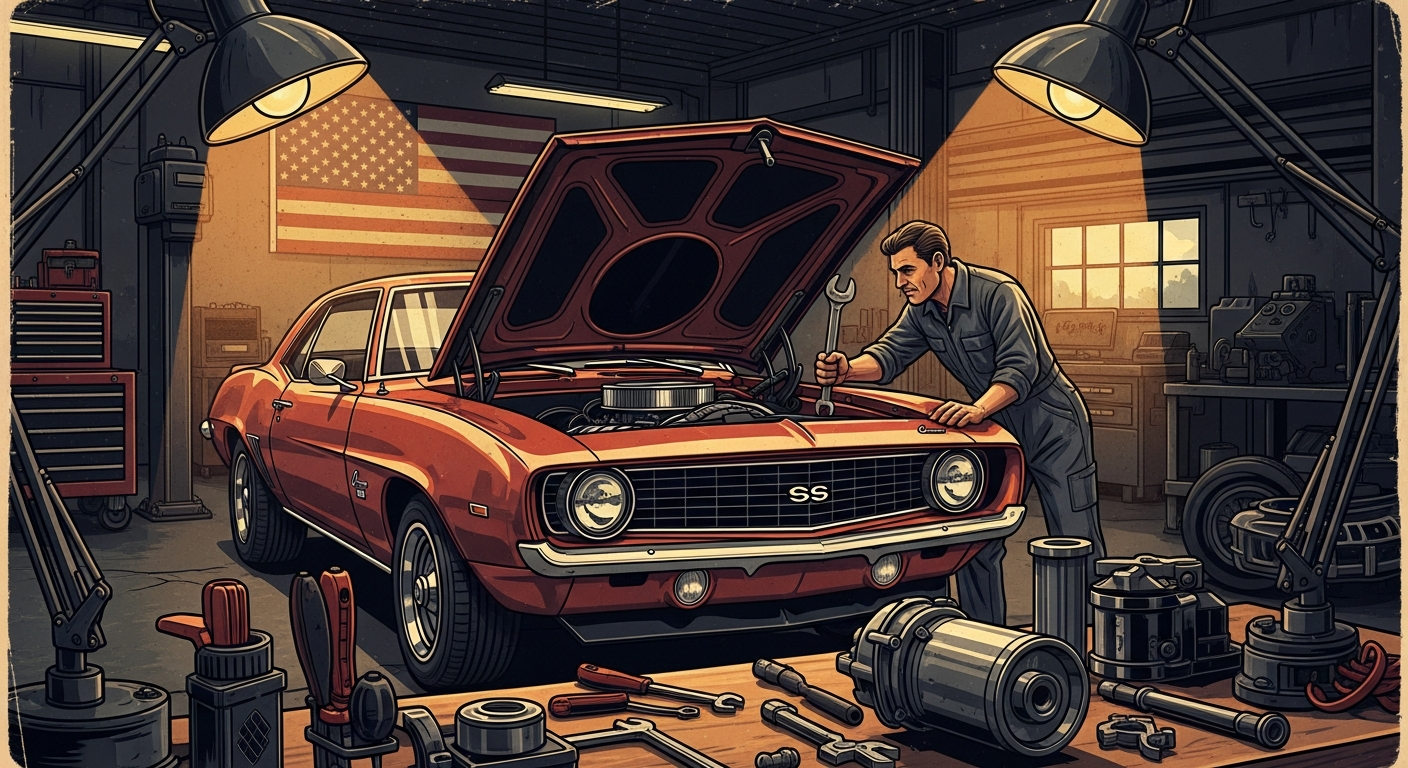
A 1969 Ford Mustang Mach 1 with a seized engine. A Chevrolet Corvette C3 with floor pans you can see the ground through. A Dodge Charger R/T that hasn't run in 15 years. These are everyday scenarios at a specialized US car workshop. The difference between a car that rots away in a barn and one that turns heads at every car show comes down to one thing: professional repair and restoration. In Germany, the demand for qualified Oldtimer workshops specializing in American vehicles has exploded over the past decade. Classic US cars – Mustangs, Camaros, Corvettes, Chargers, and Challengers – are no longer just hobby projects. They are serious investments, often worth six figures when properly restored. But the gap between a backyard hack job and professional craftsmanship is enormous. A botched restoration can destroy a car's value. A professional one can double or triple it. At Gatran Garage, we have restored, repaired, and maintained US Cars for years. We've seen every mistake in the book – and we've learned from all of them. This guide covers everything you need to know about classic car repair and restoration: the different approaches, common repairs, realistic costs, and how to find a workshop that won't let you down.
Restoration vs. Repair vs. Restomod: The Differences
Not every classic car needs a full restoration. Understanding the different levels of work helps you make the right decision for your car and your budget. The terms are often confused – even by workshops themselves. Here's what they actually mean, and when each approach makes sense:
Repair
Fixing specific issues to keep the car running and roadworthy. Targeted work on individual components – a leaking carburetor, worn brake pads, a faulty alternator. The goal is function, not perfection. Cost-effective and practical for daily drivers.
Partial Restoration
Focused restoration of specific areas: a complete engine rebuild, new interior upholstery, a full repaint, or a suspension overhaul. The car stays assembled while individual systems are brought back to original or improved condition.
Frame-Off Restoration
The gold standard. Complete disassembly down to the bare frame. Every bolt, every panel, every wire removed, cataloged, and either restored or replaced. Media blasting, rust repair, fresh paint, complete reassembly. The car returns to factory-new or better condition.
Restomod
Classic looks with modern technology. Keep the iconic design but upgrade the driving experience: disc brakes replacing drums, electronic fuel injection instead of carburetors, modern A/C, power steering, upgraded suspension. The best of both worlds.
The right approach depends on three factors: the car's current condition, your intended use (show car vs. weekend driver vs. daily), and the car's potential value after completion. A matching-numbers 1970 Chevelle SS 454 deserves a concours-quality frame-off restoration. A 1985 Camaro IROC-Z that you want to drive on weekends? A targeted repair and restomod approach makes far more financial sense.
The Most Common Repairs on US Cars & Classic Cars
After years of working on American classics, we see the same issues over and over again. Here are the most common repair areas, what causes them, and what they typically cost:
Bodywork & Rust
The number one issue on every classic US car. American cars from the 1960s through 1980s were not built for European climates. Floor pans, trunk floors, lower fenders, rocker panels, and wheel arches are the first to go. Rust doesn't just look bad – structural rust makes a car unsafe and often illegal to drive. Repair ranges from patching small spots to welding in complete reproduction panels. The key is finding ALL the rust, not just what's visible. Surface rust on a fender is cosmetic. Rust in the frame rails is structural and potentially dangerous. A proper repair involves cutting out all affected metal, welding in new steel, treating surrounding areas with rust converter, and protecting with primer and paint.
Engine & Transmission
American V8 engines are fundamentally robust, but decades of use, poor maintenance, or long storage periods take their toll. Common issues include worn camshafts and lifters (especially on flat-tappet engines), oil leaks from rear main seals and valve covers, overheating from clogged radiators or failed water pumps, and compression loss from worn piston rings. A complete engine rebuild involves disassembly, cleaning, measuring all components, machining the block and heads, replacing bearings, rings, gaskets, and reassembly with correct torque specs. Automatic transmissions like the TH350 and TH400 are workhorses but develop hard shifts, slipping, or overheating issues after high mileage.
Electrical System
Old wiring is the invisible enemy. Brittle insulation, corroded ground connections, and decades of questionable modifications create intermittent failures that are incredibly frustrating to diagnose. Ground issues cause dim headlights, flickering gauges, and starter problems. A complete rewiring with a modern harness kit (like American Autowire or Painless) is often the best long-term solution. Many owners upgrade to electronic ignition (replacing points), add USB charging ports, or install modern LED lighting while maintaining the classic appearance.
Brakes
Many classic US cars came with drum brakes on all four wheels – adequate for 1960s traffic, dangerous by modern standards. The most common upgrade is a front disc brake conversion, which dramatically improves stopping power and safety. Complete brake line replacement is often necessary on cars with original steel lines – 40+ years of corrosion makes them a burst risk. Master cylinder rebuilds, wheel cylinder replacement, and brake booster reconditioning are standard maintenance items on older vehicles.
Suspension & Steering
Worn rubber bushings, dried-out ball joints, and play in the steering are safety-critical issues on classic cars. Original rubber components harden and crack after 30-50 years, causing sloppy handling and dangerous behavior at highway speeds. Polyurethane bushing upgrades improve handling precision significantly. Power steering pumps and gear boxes develop leaks, and steering shafts develop play. A complete front-end rebuild with new ball joints, tie rod ends, idler arms, and bushings transforms the driving experience.
Cooling System
Overheating is the V8's biggest enemy. Original small-core radiators were designed for American highways, not German Autobahn or city traffic in summer. Upgrading to a high-capacity aluminum radiator with electric fans is one of the best modifications you can make. A new water pump, fresh coolant with proper antifreeze mix, and new thermostat are standard replacement items. Heater cores are notorious for leaking in classic cars, often requiring dashboard removal for replacement – a labor-intensive job.
Frame-Off Restoration: The Gold Standard
A frame-off restoration is the most thorough and most expensive way to bring a classic car back to life. The car is completely disassembled – body lifted off the frame, every component removed, tagged, and cataloged. It's a process that takes 12 to 24 months for an experienced workshop, and requires deep knowledge of the specific vehicle. Here is the complete process, step by step:
Documentation & Assessment
Before the first wrench turns, every detail is photographed and documented. Condition of all components, existing parts, missing parts, serial numbers, color codes, option codes from the data plate. This documentation is the bible of the restoration – without it, you lose track.
Complete Disassembly
Every bolt, every panel, every wiring harness is removed. All parts are organized in labeled boxes and bags. The body is lifted off the frame. Engine, transmission, axles, suspension – everything comes out. An experienced mechanic needs 40-80 labor hours for disassembly alone.
Media Blasting & Paint Stripping
Frame and body are sandblasted or media blasted with soda/walnut shells. This removes every layer of old paint, filler, undercoating, and most importantly: hidden rust. Only now does the true condition of the metal reveal itself. Some surprises are positive – some are not.
Sheet Metal & Welding
All rusty or damaged sheet metal is cut out and replaced with new steel or reproduction panels. Welding must be of the highest quality – every weld is ground and treated. The frame is measured and straightened if needed.
Priming, Body Filler & Paint
Epoxy primer for rust protection, minimal body filler where needed (filler is not a substitute for welding), surfacer, wet sanding, base coat and clear coat. A show-car paint job often requires 100+ labor hours. The difference between a standard and a show-car paint job is visible to the naked eye – costs vary depending on scope and vehicle.
Reassembly & Adjustment
All components are installed in reverse order. Engine and transmission go back in, brakes are assembled, electrical wiring is routed, interior is installed. Panel gaps are adjusted, doors aligned. This step often takes longer than disassembly – patience and precision are critical.
Break-in & Fine Tuning
The restored engine must be broken in – typically 800-1,500 km with oil changes. Carburetor or injection is tuned, ignition timing set, brakes bedded in, all systems tested for function. Only after this process is the restoration truly complete.
When a Frame-Off Does NOT Make Sense
Not every car is worth a full frame-off restoration. If the car's maximum market value after restoration is lower than the restoration costs, the math doesn't work – unless it's a family heirloom or purely a passion project. Common-production 1970s sedans, heavily modified cars with no matching numbers, and vehicles with severe frame damage often fall into this category. In these cases, a targeted repair or partial restoration makes more financial sense. Be honest about the car's potential value and your personal attachment before committing to a full restoration.
Rust: The Greatest Enemy
Rust has destroyed more classic cars than all accidents combined. American cars are particularly vulnerable because they were built for drier climates – California, Texas, Arizona. In Germany's wet, salt-heavy winters, they face conditions they were never designed for. Understanding where rust hides, how to identify it, and how to stop it is essential knowledge for every classic car owner.
Where Rust Hides
- Floor pans (under carpets – often invisible from inside)
- Trunk floor and spare tire well
- Rocker panels and lower door skins
- Frame rails and crossmembers
- Rear wheel arches and quarter panels
- Windshield and rear window channels
- Inside doors (drain holes clogged)
Surface Rust vs. Structural Rust
- Surface rust: Cosmetic issue, can be sanded and treated.
- Penetrating rust: Metal is weakened, needs welding repair.
- Structural rust: Frame or structural components compromised. Safety-critical.
Professional rust repair follows a strict process: Identify all affected areas (including hidden spots), remove all rust down to clean metal via media blasting or grinding, weld in new panels or patch panels where metal is too thin, treat surrounding areas with rust converter like POR-15 or Fertan, and protect with epoxy primer, paint, and cavity wax. For prevention, the most effective measures are professional cavity wax injection (Mike Sanders or Fluid Film), proper undercoating, and dry indoor storage during winter months.
Engine Restoration: The Heart of the Machine
The engine is what gives a classic car its soul. The rumble of a small-block Chevy 350, the roar of a Ford 428 Cobra Jet, the thunderous idle of a 440 Six Pack – these sounds are irreplaceable. A complete engine rebuild is both an art and a science. The process begins with a thorough inspection: compression test, leak-down test, oil analysis. These tests reveal whether a rebuild is necessary and how extensive it needs to be.
A full rebuild involves removing the engine, complete disassembly, hot-tanking the block to remove decades of carbon and sludge, measuring bore, crank journals, and deck height, then machining as needed – boring and honing cylinders, grinding the crankshaft, resurfacing heads. New pistons, rings, bearings, camshaft, lifters, timing chain, oil pump, and gaskets go in. The heads get new valve guides, seats, and springs. Everything is assembled with precise torque specifications and break-in procedures must be followed exactly.
Matching Numbers: Why They Matter
A 'matching numbers' car has its original engine – the one installed at the factory, verifiable by VIN-stamped casting numbers. For collectible muscle cars, this can mean a 30-50% premium in value. A 1970 Chevelle SS 454 LS6 with matching numbers can be worth significantly more than the same car with a replacement engine. Preserve matching numbers whenever possible – even if a rebuild is more expensive than a swap.
Common V8 Problems
- Cam & lifter wear: Flat-tappet cams need zinc-rich oil (ZDDP)
- Rear main seal leak: Classic issue on all American V8s, requires engine or trans removal
- Intake manifold gasket: Coolant leak into oil or externally, common on Chevy small-blocks
- Overheating: Undersized radiators for German conditions, water pump failure
The decision between originality and performance upgrades is personal. For show cars and investment vehicles, keeping everything factory-original is the right choice. For drivers who want to enjoy their cars, modern upgrades like electronic fuel injection, an upgraded camshaft, or aluminum heads can dramatically improve drivability while maintaining the classic character. A professional workshop can help you find the right balance – the scope and cost of an engine rebuild depend entirely on the vehicle and the desired result. Contact us for an individual quote.
Finding the Right Workshop
Choosing the right workshop is the single most important decision in any restoration project. A good workshop can turn a basket case into a show winner. A bad one can take your money, your time, and deliver substandard work that needs to be redone. General workshops – even good ones – often lack the specialized knowledge needed for American vehicles. US Cars use different fastener standards (SAE vs. metric), different electrical systems, different engine architecture, and parts sourcing requires specialized supplier networks.
Green Flags
- Portfolio of completed restorations with photos
- Specialization in US vehicles / classic cars
- Written cost estimates before work begins
- Transparent communication and regular updates
- Customer references you can actually contact
- Proper tools and equipment for US cars
Red Flags
- No photos of previous work
- Unrealistically low prices or fast timelines
- No written estimate – only verbal agreements
- Reluctance to show workshop or current projects
- Large upfront payment demands (50%+)
- No US car-specific experience or knowledge
At Gatran Garage in Wimsheim near Stuttgart, US Cars are our specialty – not a side project. We work on Mustangs, Camaros, Corvettes, Chargers, and everything else with an American V8. From small repairs to complete frame-off restorations, we provide transparent cost estimates, regular progress updates with photos, and craftsmanship that speaks for itself. Every project gets the attention it deserves, because we know these cars aren't just vehicles – they're passion, history, and investment rolled into one.