
A 1969 Dodge Charger R/T with a swollen fuel hose that had been slowly weeping petrol onto the exhaust manifold for months. A 1972 Ford Mustang Mach 1 with a seized carburettor — the main jet completely clogged by dissolved deposits the previous owner had never noticed. A 1965 Chevrolet Corvette with a tank corroded from the inside out after two winters of storage with partially-filled E10 fuel. These are not extreme cases. We see them regularly at Gatran Garage. The common thread: all three owners had no idea that E10 — the standard fuel at German petrol stations since 2011 — is fundamentally incompatible with the original fuel systems of classic US cars. The damage is real, expensive to repair, and entirely preventable.
What is E10 — and why does it matter for vintage vehicles?
Since 2011, E10 has been the standard fuel at most German petrol stations. The name tells you exactly what it contains: E10 is regular petrol blended with up to 10% ethanol, a bio-based alcohol derived from fermented plant matter — corn, sugarcane, wheat. The ethanol content was introduced to reduce fossil CO₂ emissions and satisfy EU renewable energy targets. For modern vehicles built after approximately 1995–2000 with fuel injection, modern rubber compounds and stainless steel components, E10 is largely unproblematic. Manufacturers explicitly tested and approved these materials for ethanol exposure.
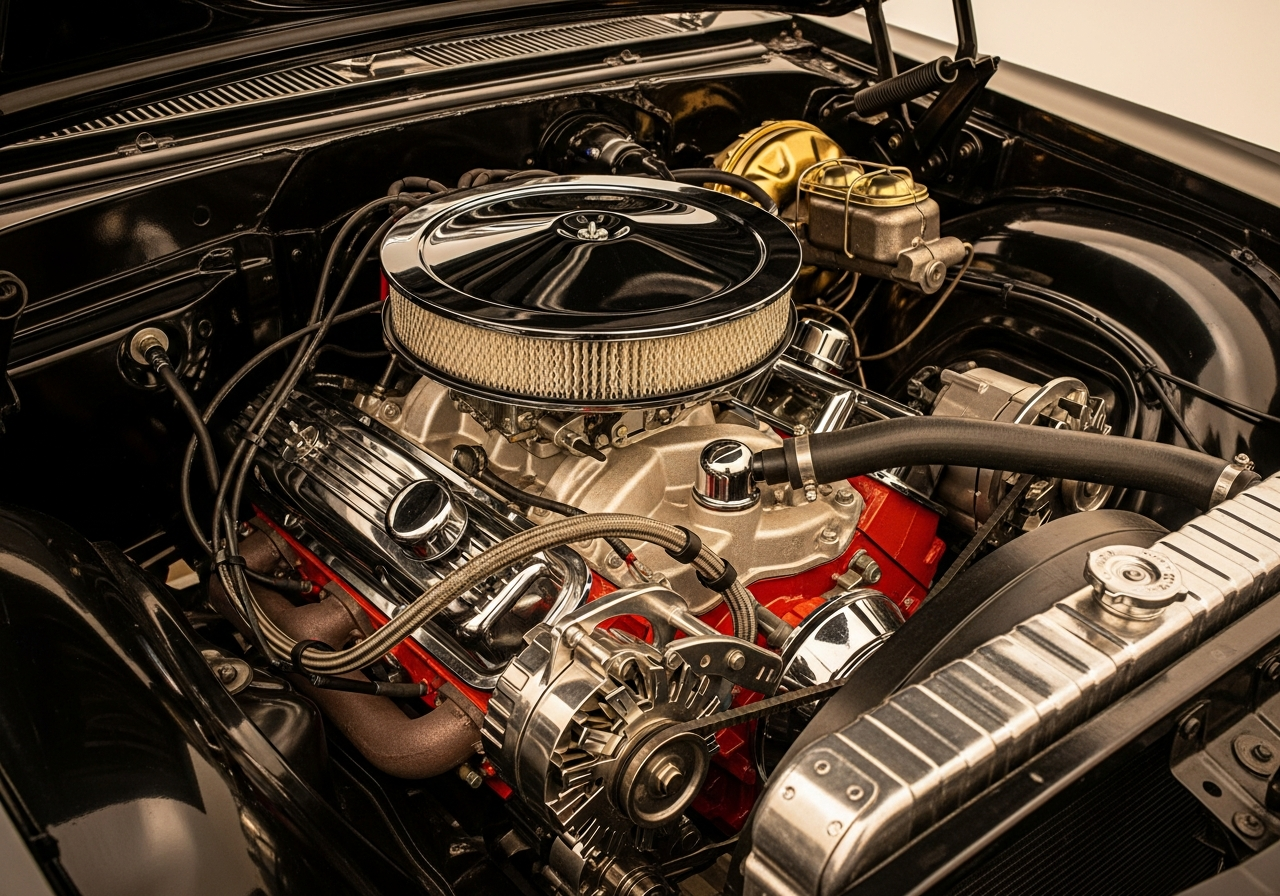
For classic US cars from the 1960s, 70s and early 80s, however, the situation is fundamentally different. These vehicles were engineered in an era when fuel was pure petrol — no ethanol, no oxygenates of any kind. The Holley carburettors, Rochester Quadrajet units, Carter AFBs and Autolite four-barrels that powered Mustangs, Camaros, Chargers and Corvettes were calibrated for pure petrol. Their zinc and aluminium internal components, their cork and nitrile rubber gaskets, their natural rubber fuel hoses — none of these were designed for contact with ethanol. And therein lies the problem.
Ethanol has a fundamentally different chemical character to petrol. It is polar — it mixes with water. It is a powerful solvent — it dissolves organic materials and some metals. And it is hygroscopic — it actively absorbs moisture from the surrounding air. Each of these properties creates a specific and distinct risk for vintage US car fuel systems. Understanding them separately is the first step to protecting your vehicle.
Four ways E10 damages your classic US car
1. Hose and seal degradation — the silent leak
Original fuel hoses in US cars from this era are made of natural rubber or early synthetic compounds that were never formulated for ethanol contact. Ethanol penetrates these materials and causes them to swell, soften and eventually crack — a process that can take months or years but is essentially irreversible. The first sign is often a faint petrol smell inside the garage. By the time you can smell it, the hose is already compromised.
Carburettor gaskets — often made of cork or early nitrile rubber — are equally vulnerable. A swollen carburettor gasket causes fuel to bypass the metering circuits, leading to erratic mixture, poor idle and increased fuel consumption long before any leak becomes visible. The same applies to the rubber diaphragm inside the fuel pump, which hardens and cracks with ethanol exposure, eventually causing fuel delivery failure.
2. Carburettor corrosion and jet clogging — the solvent effect
Ethanol is an outstanding solvent — far more aggressive than petrol. Inside the carburettor, this causes two distinct problems. First, it dissolves the varnish deposits and gum residues that have built up inside the carburettor over decades. These dissolved particles then travel downstream and clog the precision-machined jets and passages. A Holley 750 double-pumper or a Rochester Quadrajet running on E10 will develop stumbles, hesitation and flat spots as the main jets gradually restrict.
Second, and more seriously, ethanol attacks the zinc and aluminium alloys used extensively in vintage carburettor bodies. Zinc-rich components — common in die-cast carburettor parts — develop a white powdery corrosion product when exposed to ethanol over time. This corrosion pits the smooth internal surfaces, permanently altering the fuel flow characteristics and eventually making carburettor rebuild insufficient — the body itself needs replacement.
3. Phase separation and tank corrosion — the water trap
This is arguably the most dangerous E10 effect for stored vehicles, and it is particularly relevant for US cars in Germany where classic cars often stand for six months or more over winter. Ethanol is hygroscopic — it actively draws moisture from the surrounding air through the tank vent. As long as the ethanol-water mixture stays below saturation point, it remains dissolved in the fuel. But once the water content exceeds approximately 0.5%, phase separation occurs: the ethanol and water literally separate from the petrol and sink to the bottom of the tank as a distinct layer.
The consequences are twofold. The water-ethanol layer at the tank bottom accelerates corrosion of the inner tank walls — steel tanks, which are standard on virtually all classic US cars, rust from the inside out. The rust particles then travel through the fuel system, blocking the filter, damaging the fuel pump and reaching the carburettor. Simultaneously, when the engine is started after winter storage, the first thing it draws up is the water-ethanol layer — causing rough running, misfires and in severe cases hydrolocking of cylinders.
4. Reduced energy content and lean running — the performance thief
Ethanol contains approximately 34% less energy per litre than pure petrol. When a classic US car carburettor is jetted for pure petrol — as all original factory units were — substituting E10 effectively leans out the air-fuel mixture. A correctly-jetted Holley on pure petrol might run at 13.5:1 air-fuel ratio. On E10, the same jets will produce a leaner mixture, pushing the ratio toward 14:1 or beyond. A lean-running engine runs hotter, is more prone to detonation and over time causes accelerated valve seat recession — particularly critical on US engines designed before the era of hardened exhaust valve seats.
The driver notices increased fuel consumption, reduced throttle response and a slight roughness at idle — symptoms that are easy to attribute to other causes, allowing the lean condition to persist for months while slowly damaging the engine.
Which US cars are most at risk — and why
The rule of thumb is clear: the older and more original the vehicle's fuel system, the higher the risk. Vehicles with carburetted engines and intact original fuel systems are in the highest risk category. Conversely, a US car that has already had its fuel system modernised — ethanol-compatible hoses, modern seals, EFI conversion — has substantially lower risk. Here is how the most common models break down:
Ford Mustang (1964½–1985)
HighFactory carburettors (Autolite, Holley, Motorcraft) use zinc-rich die-cast bodies and cork/nitrile gaskets. Early Mustangs have natural rubber fuel hoses. The 289, 302, 351 and 390 V8s were all calibrated for pure petrol. Fox-body Mustangs (1979–1985) with carburettors are similarly at risk.
Chevrolet Camaro (1967–1981)
HighRochester Quadrajet carburettors have known zinc corrosion issues with ethanol. The original rubber fuel lines and cork gaskets are particularly vulnerable. Small block 350 and big block 396/402 engines run lean on E10 without re-jetting.
Dodge Charger (1966–1978)
HighCarter AFB and Holley carburettors are both vulnerable to ethanol attack. The large-capacity steel tanks on B-body Mopars are particularly susceptible to phase separation corrosion during storage. 383, 440 and 426 HEMI engines were all jetted for pure petrol.
Chevrolet Corvette C1–C3 (1953–1982)
Very HighDespite the fibreglass body, Corvettes have entirely conventional steel fuel systems. The fuel-injected Rochester units on 1957–1965 Corvettes are extremely sensitive to ethanol — the precision-machined passages are easily clogged by dissolved deposits. C3 Corvettes with Quadrajet carburettors face the same zinc corrosion risk as Camaros.
Chevrolet Bel Air (1950–1970)
Very HighThese vehicles have been standing in collections for decades with entirely original fuel systems. The combination of aged natural rubber hoses, old tank sealant and carburettors that have never been rebuilt makes them among the most vulnerable classic US cars to E10 exposure.
Ford Thunderbird (1955–1976)
HighEarly Thunderbirds share the same Holley and Autolite carburettor vulnerabilities as contemporary Mustangs. The more complex fuel systems of mid-70s Thunderbirds with their early emissions controls add additional potential failure points when exposed to ethanol.
Six proven measures to protect your US car from E10 damage
The good news: E10 damage is entirely preventable. A combination of the right fuel choice and targeted preventive maintenance is sufficient to keep your classic US car safe indefinitely — even in Germany where ethanol-free fuel is not widely available. Here is what we recommend at Gatran Garage, based on years of working with these vehicles:
Always use Super Plus (E5) or ethanol-free premium fuel
This is the single most important step, and it costs nothing extra compared to E10. Super Plus with a minimum 98 octane rating contains a maximum of 5% ethanol (E5 classification) — half the ethanol content of E10. More importantly, some premium fuels at major chains are effectively ethanol-free: Shell V-Power and Aral Ultimate regularly test at 0–2% ethanol content in Germany. Check the label on the pump — by law, fuel retailers must display the maximum ethanol content. Choosing E5 over E10 reduces every ethanol-related risk by at least 50%. For a vehicle worth €30,000–€100,000+, the extra few euros per fill-up are negligible.
Add a fuel stabiliser for every fill-up and especially for storage
Ethanol-specific fuel stabilisers neutralise the hygroscopic properties of ethanol, prevent phase separation and protect metal and rubber components throughout the fuel system. Products like Star Tron Enzyme Fuel Treatment, Sta-Bil Ethanol Treatment or Lucas Fuel Stabilizer are widely available and inexpensive. For daily use, a small dose per fill-up is sufficient. For winter storage, use a double dose and fill the tank completely to minimise the air space above the fuel — less air means less moisture absorption. A full tank with stabiliser is the single best thing you can do before putting your US car away for the winter.
Replace all fuel hoses with ethanol-compatible materials
If your US car still has its original rubber fuel hoses — which is the case for the majority of unrestored vehicles — replacing them with modern ethanol-compatible hoses is one of the best investments you can make. PTFE-lined hoses (polytetrafluoroethylene — the same material as Teflon) are completely impervious to ethanol and to all other fuel additives. They are available in the correct diameters for all common US carburettor and fuel system connections. SAE J30 R9-rated fuel hoses are the minimum specification for ethanol compatibility. The cost of a complete fuel hose replacement on a typical US car is typically €200–400 in parts and a few hours of labour — negligible compared to the cost of a flooded garage or an engine damaged by water ingestion.
Have the carburettor inspected and rebuild with modern seals
Modern carburettor rebuild kits for virtually every US carburettor — Holley, Rochester, Carter, Autolite — are now available with ethanol-compatible synthetic rubber seals and gaskets that replace the original cork and nitrile parts. A proper carburettor rebuild takes 4–6 hours and costs €150–350 in a specialist workshop. It eliminates the most common failure points, restores correct fuel metering and leaves the carburettor correctly jetted for the fuel you will be using. If you're running E10 or E5 exclusively, a slight re-jetting to richer settings compensates for the reduced energy content of ethanol and prevents lean running. Have this checked by a specialist who understands vintage US carburettors — generic workshop advice here is unreliable.
Inspect and protect the fuel tank — inside and out
Steel tanks that have been exposed to E10 should be inspected internally for corrosion at least every two to three years. A borescope inspection of the tank interior, combined with a sample of the fuel drawn from the tank sump, tells you immediately whether phase separation and corrosion are occurring. If the tank shows early-stage rust, a tank coating with POR-15, KBS Gold Standard or similar ethanol-resistant sealant is an effective solution — the coating creates a barrier between the steel and the fuel, stopping further corrosion. If the tank is already heavily corroded, replacement is the only safe option. Aluminium or stainless steel replacement tanks are available for most common US cars and are inherently E10-compatible.
Annual fuel system inspection by a US car specialist
The fuel system of a classic US car is not something you can reliably assess yourself from the outside. Hairline cracks in fuel hoses look identical to intact hoses until the moment they fail. Early-stage carburettor corrosion is invisible from the outside. Internal tank corrosion produces no external symptoms until the filter begins clogging. A specialist who knows these vehicles can assess the complete fuel system — from the tank sender unit to the needle and seat in the carburettor float bowl — in two to three hours. This annual inspection is cheap compared to the cost of a fuel system failure, or a fire. At Gatran Garage, we include a fuel system condition check as standard in our annual service for every classic US car we look after.
The bottom line: E10 is manageable — but only with awareness
E10 does not automatically destroy your US car. Many classic vehicles have been running on E10 or E5 for years without visible problems — because their owners made the right choices. The critical mistakes are using E10 in an unmodified original fuel system, storing the vehicle over winter with a partially-filled tank and no stabiliser, and ignoring the fuel system during routine maintenance. Get those three things right and E10 becomes a manageable reality. Get them wrong and the repair bill for a single preventable failure — a fuel leak, a seized carburettor, a corroded tank — will dwarf the lifetime cost of using Super Plus and adding stabiliser.