
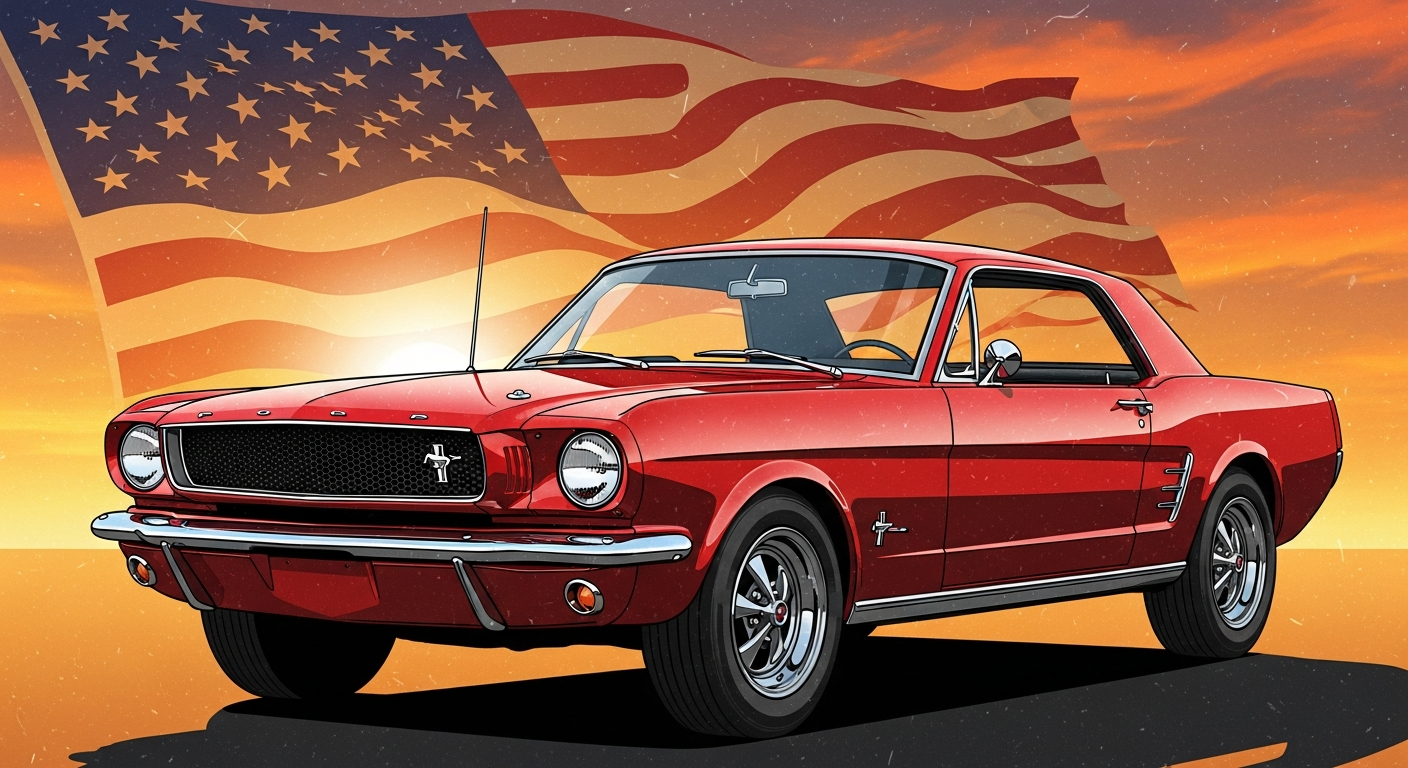
The roar of the engine, the timeless silhouette. The Ford Mustang is more than just a car. Since its unveiling on April 17, 1964 at the New York World's Fair, it has not only revolutionized the automotive world but also set technical innovations that endure to this day. In this article, we explore the technical masterpieces that made the Mustang an icon.
1964-1973: The Birth of a Legend
When Lee Iacocca presented the first Mustang in 1964, the concept was revolutionary: an affordable, sporty car for the masses. Technically, the first Mustang was based on the Ford Falcon platform, but Ford's engineers created something entirely new from it.
The original 260 Cubic Inch V8 with 164 hp was just the beginning. Already in 1965, Ford introduced the legendary 289 V8, which offered true muscle car performance with up to 271 hp in the High-Performance K-Code version. The technical refinement was in the details: high-performance camshafts, improved cylinder head designs, and a four-barrel carburetor turned the compact V8 into a true powerhouse.
Engine Variety
From economical six-cylinders to brutal Big-Block V8s. The Mustang offered an unparalleled range of engines for every taste and budget from the very beginning.
Suspension Tuning
The Sport Handling Package offered stiffer springs, stabilizer bars, and more capable shock absorbers. Innovative for its time.
1967 marked a turning point: Ford introduced the 390 Cubic Inch Big-Block V8. The first true Big-Block in the Mustang. With 320 hp, it offered brutal torque and definitively established the Mustang as a muscle car. But the true technical masterpiece was integrating this massive engine into the compact platform without compromising handling too much.
The pinnacle of this era was undoubtedly the legendary Boss 429 from 1969-1970. Developed to homologate Ford for NASCAR, this engine offered 375 hp (officially. unofficially significantly more). The technical challenges were enormous: the massive Hemi head required extensive body modifications, including widened wheel wells and reinforced frame components.
1974-1993: Adapting to New Times
The oil crisis of the 1970s forced Ford into a radical rethinking. The 1974 Mustang II was technically a complete restart: smaller platform (based on the Ford Pinto), more modest engines, but also innovative solutions for efficiency and emission control.
The 2.3L four-cylinder with turbocharger in the Mustang SVO (1984-1986) was a technical masterpiece of efficiency: 175 hp from a four-cylinder, combined with advanced electronics and intercooler technology. For many purists, this was sacrilege, but technically it was ahead of its time.
The Fox-Body era (1979-1993) brought another technical breakthrough: the introduction of electronic fuel injection (EFI) in the 5.0L V8 starting in 1986. This dramatically improved not only performance (225 hp) but also reliability, efficiency, and emissions.
Electronics Revolution
From the 1980s onwards, Mustangs increasingly integrated electronic controls for engine, transmission, and driving dynamics. A quantum leap in precision.
Safety Features
ABS brakes, airbags, and improved crash structures made the Mustang not only faster but also safer.
1994-Today: Modern Performance Meets Heritage
The SN-95 Mustang (1994-2004) combined retro-inspired design with modern technology. The modular 4.6L V8 replaced the old 5.0L and initially offered a modest 215 hp, but it became the foundation for later high-performance engines.
The technical masterpiece of this era was the 2003 SVT Cobra: a supercharged 4.6L V8 with 390 hp and a fully independent rear suspension system (IRS). This IRS was a revolution for the Mustang. Better traction, more precise handling, and greater comfort without compromising performance.
The S197 Mustang (2005-2014) brought another breakthrough: the return to a solid rear axle, but in optimized form. The 5.0L Coyote V8 (introduced in 2011) was a technical masterpiece: aluminum block and heads, variable valve timing (Ti-VCT), 412 hp from 5.0 liters of displacement. And all with acceptable fuel consumption.
The current S550 generation (from 2015) unites the best of all worlds: an independent rear suspension system for all models, adaptive magnetic dampers, electronic drift modes, and the Shelby GT500 with its supercharged 5.2L V8 and 760 hp. The most powerful street Mustang ever built.
The Future: Electrification and Preservation
With the Mustang Mach-E, Ford took the step into the electric era in 2020. Even though purists protested, the Mach-E demonstrates Ford's commitment to carrying the Mustang name into the future. Technically impressive: up to 480 hp from electric motors and a range of over 400 km.
But Ford has understood: the classic V8 Mustang remains. The S650 generation (from 2024) shows that V8 performance and modern technology can go hand in hand. Features like digital displays, advanced driver assistance systems, and over-the-air updates meet the iconic 5.0L Coyote V8.
Conclusion: 60 Years of Innovation
The Ford Mustang is not only a symbol of American automotive culture but also a testament to continuous technical innovation. From the first 260 V8 engines through the turbo four-cylinders of the 1980s to the modern Coyote V8s and electric powertrains. The Mustang has constantly reinvented itself technically without losing its soul.
At Gatran Garage, we understand the technical complexity of every Mustang generation. Whether you want to restore a classic 1967 Boss or tune a modern GT500. Our decades of experience with American muscle cars makes us the ideal partner for your project.