
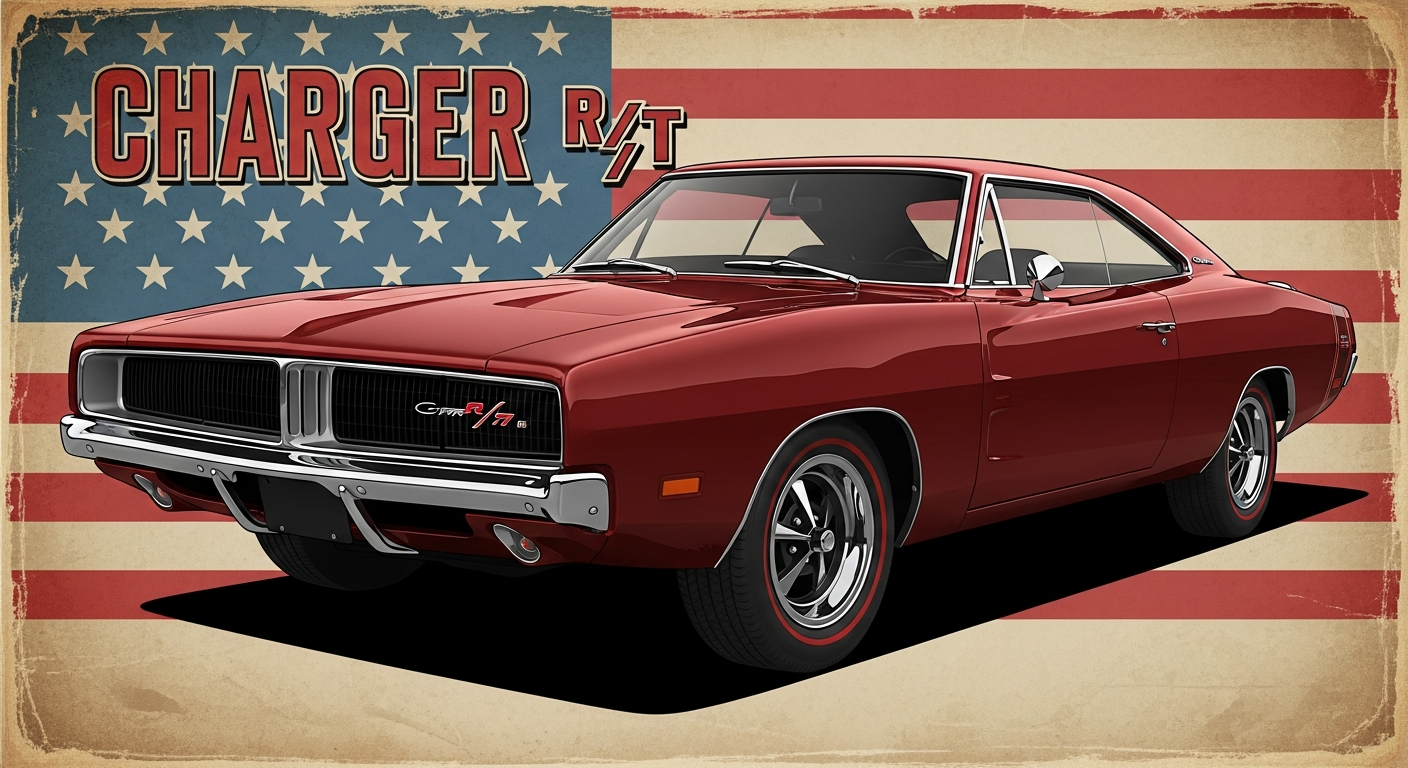
When you hear the deep rumble of a 426 HEMI or 440 Magnum approaching, you know: This is no ordinary car. The Dodge Charger R/T from 1968 to 1970 is more than just a vehicle. It's a symbol of an era when American automakers competed for the most powerful, wildest, and most impressive muscle cars. The 1969 model year represents the pinnacle of this evolution. A design masterpiece that has lost none of its fascination over 55 years later.
The Birth of a Legend: 1966-1967
The story of the Dodge Charger begins in 1966. Dodge recognized that a new market segment was emerging. Young buyers wanted sporty, powerful cars with aggressive looks. The first generation Charger (1966-1967) was Dodge's answer to this demand.
Although the first Charger was successful, Dodge's designers knew they could do better. Under the direction of design chief William Brownlie, work began on a completely new body that would make automotive history. The goal: to create a car that combined aerodynamic efficiency, aggressive stance, and unmistakable presence. The result was the 1968 Dodge Charger. A revolution in automotive design.
Iconic Design
The Coke bottle shape and hidden headlights defined a new era of automotive aesthetics
Raw V8 Power
From 440 Magnum to 426 HEMI. Up to 425 hp of pure American muscle
Racing Heritage
Dominant in NASCAR and legendary in film history through Bullitt
The Perfect Year: 1969 Charger R/T
The 1969 Dodge Charger is considered by many experts as the most beautiful muscle car ever built. Compared to the 1968 model, subtle but significant changes were made. The grille was divided in the center, giving the front an even more aggressive look. The taillights were revised, and the overall appearance was refined without losing the raw charisma.
The designation R/T stands for "Road/Track" and signaled that this Charger was equally suitable for the street and the racetrack. The R/T package was not just a badge. It included a performance package with upgraded suspension, heavy-duty brakes, and the choice of powerful V8 engines.
Heart of the Beast: The Legendary Engines
The power of the Dodge Charger R/T came from two legendary engines. The standard engine was the 440 Magnum. A 7.2 liter V8 with 375 hp and a massive 664 Nm of torque. This engine was the perfect combination of performance and reliability. With a single four-barrel carburetor, the 440 delivered smooth, linear power that made the Charger incredibly fast on the street.
440 Magnum V8
- Displacement: 7.2 liters (440 cui)
- Power: 375 hp at 4,600 rpm
- Torque: 664 Nm at 3,200 rpm
- Carburetor: Carter 4-barrel
426 HEMI V8
- Displacement: 7.0 liters (426 cui)
- Power: 425 hp at 5,000 rpm
- Torque: 664 Nm at 4,000 rpm
- Carburetor: Dual Carter 4-barrel
But for the absolute power enthusiast, there was the 426 HEMI. The "Elephant Engine" was a legend in its own right. With hemispherical combustion chambers (hence "HEMI"), dual four-barrel carburetors, and an uncompromising racing design, the HEMI produced 425 official hp. Insiders know that the actual power was significantly higher. Some estimates speak of up to 500 hp. The HEMI Charger accelerated from 0 to 100 km/h in under 6 seconds. A sensational value for 1969.
Design Philosophy: Form Follows Function
The design of the 1969 Charger was not just beautiful. It was functional. The so-called "Coke bottle" shape was not only aesthetically pleasing but also improved aerodynamics. The recessed rear window (called "flying buttress" C-pillars) not only looked dramatic but also reduced air turbulence at high speeds.
The hidden headlights are perhaps the Charger's most distinctive feature. Electrically operated, they disappeared completely into the grille when not in use, giving the front a clean, menacing look. When illuminated, they gave the Charger an almost robotic appearance. This feature alone makes the second-generation Charger instantly recognizable.
Exterior Features
- Hidden headlights in the grille
- Flying buttress C-pillars
- Coke bottle side profile
- Full-width taillights
- Bumblebee stripe (optional)
Interior Features
- Bucket seats or bench seat
- Full instrumentation
- Pistol grip shifter (4-speed)
- Woodgrain accents
- Rally instrument cluster
Racing Success: Born to Win
The Dodge Charger was not only a street car. It was a racing weapon. In NASCAR, the Charger dominated from 1968 to 1970. The aerodynamic shape gave it a significant advantage at high speeds on the superspeedways. In 1969, Dodge introduced the legendary Charger 500 and later the Charger Daytona with its iconic nose cone and rear wing. The Daytona was the first car in NASCAR history to break the 200 mph barrier.
But the Charger's most famous appearance was not on a racetrack. It was in the 1968 film "Bullitt". The epic chase scene through San Francisco, with a black Charger R/T against Steve McQueen's Ford Mustang GT, is considered the best car chase in film history. This 10-minute sequence cemented the Charger's status as an automotive icon for all time.
Charger Restoration: Expert Tips
A Dodge Charger restoration requires specialized knowledge and access to quality parts. At Gatran Garage, we have decades of experience with Mopar muscle cars and know the specific challenges of these vehicles.
Rust Problem Areas
Classic Charger weak points where rust typically occurs first:
- Lower fenders and wheel wells
- Trunk floor and drop-offs
- Rear frame rails
- Door bottoms and rocker panels
Our Restoration Services
Complete Mopar restoration from a single source:
- 440 & HEMI engine rebuilds
- TorqueFlite transmission service
- Complete body restoration
- Original color matching
The Charger Today: Investment and Passion
Today, the 1969 Dodge Charger R/T is one of the most sought-after muscle cars in the world. Prices for restored vehicles range from $80,000 for well-restored 440 Magnum cars to over $200,000 for rare HEMI examples. Original, numbers-matching HEMI Chargers can even exceed $300,000 at auction.
But beyond the investment aspect, the Charger offers something that cannot be measured in money: the pure driving experience. The sound of a 440 or HEMI, the raw power under your right foot, the attention on every street. These are experiences that make the Dodge Charger a true passion.
Conclusion: An Eternal Icon
The Dodge Charger R/T of the second generation (1968-1970) represents the pinnacle of American muscle car design and engineering. The combination of aggressive styling, powerful engines, and racing success created a vehicle that has influenced automotive culture for over half a century. Whether in film, motorsport, or as a collector's piece, the Charger remains an undisputed icon.
At Gatran Garage, we understand the passion for these legendary machines. Whether you're looking to restore your Charger to concours condition, maintain it as a driver, or simply need expert advice, our team has the experience and expertise to bring your Mopar dream to life.