
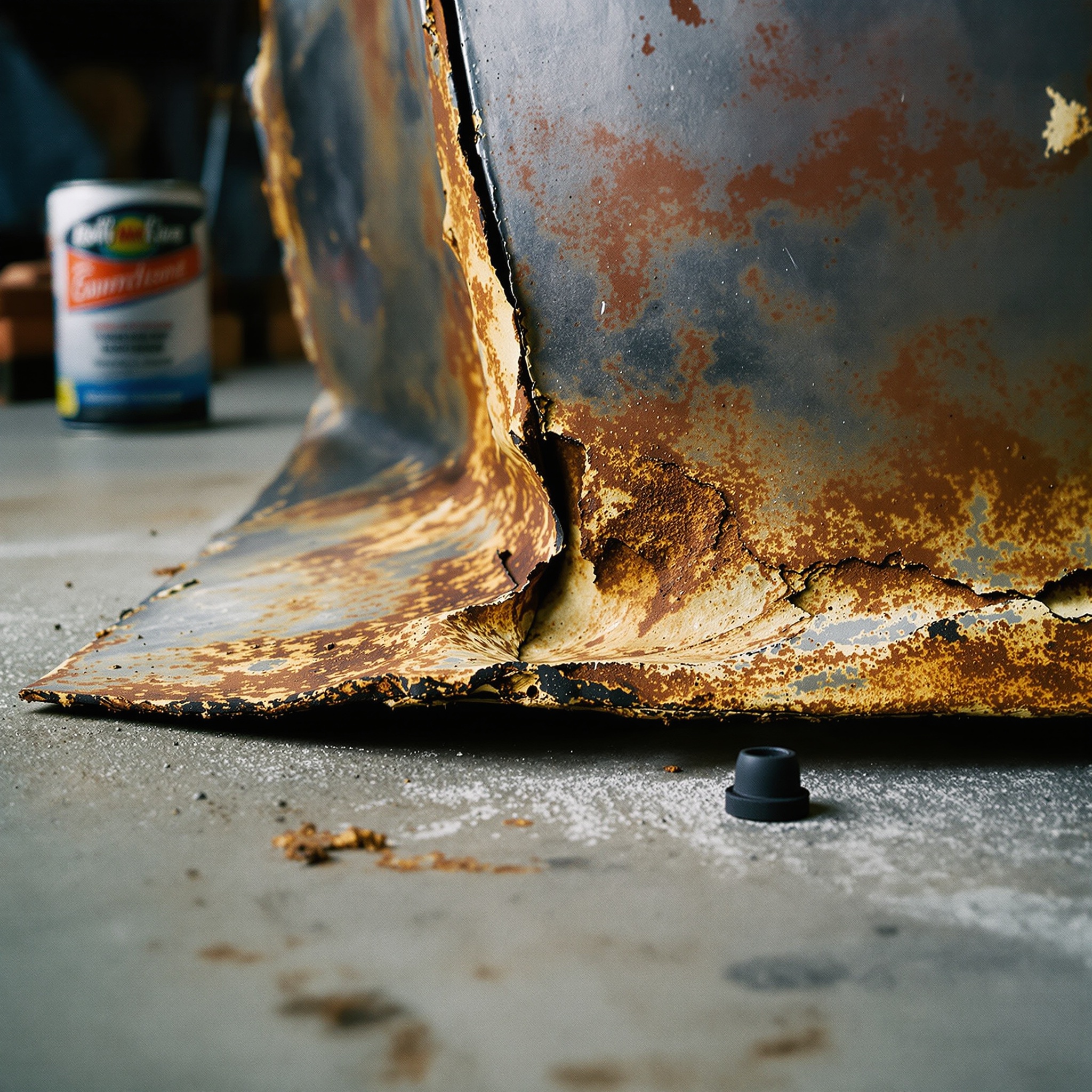
Unlike German vehicles, American manufacturers in the 1960s and 70s often used simpler production processes. Water traps between body panels, insufficient seals and thin sheet metal in certain areas lead to characteristic rust problems today. Anyone who knows these traps can brief their classic car workshop precisely — or prioritise the right areas for a planned Corvette restoration.
Hidden Water Traps in the Bodywork
The most common cause of rust in American vehicles is structural water traps. Unlike modern designs, classic muscle cars often had multi-layer body structures without adequate drainage. Water collects between the sheet metal layers and can corrode unnoticed for decades.
Particularly critical are the rear wheel arches on Camaro and Mustang. Three layers of sheet metal often meet here: the outer body, a reinforcement panel and the inner structure. Cavities form between these layers where moisture collects. In a professional Ford Mustang restoration, these areas must be completely opened up and resealed.
Typical water traps by model
- Rear wheel arches
- Cowl area below windscreen
- Sill connections
- Lower door frames
- Boot floor
- Connection to rear axle
- Base of A-pillar
- Engine bay firewall
Sills and Floor: Structural Weak Points
Chevrolet restorations consistently show: the sills of American muscle cars are structural weak points. Unlike European vehicles, they were often made as simple U-profiles, without the complex bracing of modern constructions. These profiles collect dirt and salt, especially at the connection points to the floor.
A particular problem is the so-called Rocker Panels — the sill trim under the doors. On many American classics these are only clipped or weakly welded on. Moisture enters through the smallest gaps and corrodes from the inside out. When the first rust blisters become visible on the outside, the underlying structure is often already severely attacked.
The floor itself shows typical patterns in restoration projects: rust typically begins at the welds between the floor pan and the bracing. American manufacturers of the time often used simple overlap welds without additional sealing. After 40–50 years, characteristic pitting corrosion develops here.
Preventive measure: sill check in winter storage
During professional winter storage, a sill inspection is a standard procedure. Vehicles are thoroughly inspected on the lift before they enter the climate-controlled facility. Small rust spots can be stopped with special sealants before they cause structural damage.
Engine Bay and Firewall
The engine bay of classic American muscle cars hides special rust traps that remain invisible to the naked eye. The firewall between the engine bay and passenger compartment is a critical area, particularly on vehicles with air conditioning. Pipes and wiring looms run through feedthroughs that were often inadequately sealed.
Engine overhauls regularly reveal corroded areas around the pedal assembly. Moisture from the engine bay penetrates through defective feedthroughs into the passenger compartment and attacks the firewall bracing. These damages are particularly critical as they affect the structural integrity of the vehicle.
A further hotspot are the engine mount housings. American V8 engines exert considerable stress on the mounting points due to their mass and power output. Micro-cracks in the welds develop through decades of use and become entry points for corrosion.
Boot and Rear Section: Problem Zone
The boot is often the area most heavily affected by rust in Dodge Challenger and Charger restoration work. Over the years, moisture accumulates here through leaking seals or defective drainage openings. Particularly problematic is the transition from the boot floor to the rear axle — an area with many welds and bracings.
The spare wheel well is a classic water collector. Many American muscle cars have only a simple recess here without drainage. Condensation collects at the lowest point and leads to large-area rust-through. In professional bodywork repairs, the entire boot floor often has to be renewed.
Additional rear rust points
- Rear window area: Leaking rubber seals allow water into the body
- Tail light housings: Corrosion around fixing points
- Tank brackets: Rust from rising moisture from the underside
Chrome Parts and Their Fixing Points
The characteristic chrome trims of American muscle cars are not just visual highlights — they are also potential rust traps. Chrome work regularly reveals that the fixing points for bumpers, trim strips and emblems are particularly susceptible to corrosion.
Chrome parts are mostly fixed with stainless steel screws or clips. Contact between different metals (galvanic corrosion) accelerates the rust process at fixing points. Additionally, moisture collects in the gaps between the chrome part and the bodywork. During a professional respray, these areas must be treated with particular care — old fixing holes are often completely welded up and re-drilled to create a rust-free base.
Doors and Window Frames: Often Overlooked
The door construction of American muscle cars followed different principles to European vehicles. Thicker panels but simpler drainage concepts lead to characteristic rust patterns. The lower door frame is always a critical point during vintage car service inspections.
The areas around the door hinges are particularly susceptible. The constant opening and closing creates micro-movements that damage seals and paintwork. Moisture enters and corrodes from the inside out. This aspect is often overlooked in restoration consultations but can lead to expensive repairs later.
The window guides are another problem area. American vehicles often had complex lift mechanisms for the side windows. The guide rails collect condensation water and are difficult to clean. Over the years, corrosion nests form here that can affect the entire window mechanism.
Professional Rust Diagnosis and Prevention
A proper rust diagnosis goes far beyond a visual inspection. Gatran Garage uses special endoscope technology to inspect even hidden cavities. Magnetic paint thickness gauges show where filler or repairs have already been carried out. This information is crucial for realistic cost planning in US car restoration.
Our diagnostic procedure
Modern rust protection procedures have advanced significantly. Instead of the cavity wax sealants that were common in the past, long-term corrosion protection concepts are now used. These combine structural repairs with chemical rust converters and permanent sealing systems. Critical areas are not only repaired, but constructively improved: additional drainage holes, reinforced welds and improved sealing concepts ensure that restored vehicles remain rust-free in the long term.
Frequently Asked Questions
Which American muscle cars rust the fastest?
Vehicles from the late 1960s and early 1970s are most affected. Ford Mustang model years 1969–1973 and first-generation Chevrolet Camaro show the most common rust problems. This is due to the manufacturing methods and sheet metal quality of that era. A professional Ford Mustang workshop can treat these model-specific weak points in a targeted way.
Can surface rust be treated at home?
Surface rust on accessible areas can be treated with the right equipment. However, structural rust damage or problems in cavities require professional bodywork repair. Improper treatment can lead to greater damage and significantly increase the cost of restoration.
How long does complete rust removal take?
Depending on the extent of damage, complete rust treatment can take anywhere from a few days to several months. A full frame-off restoration of a severely rusted muscle car typically takes 3–6 months. Gatran Garage provides a detailed time and cost estimate after the initial inspection.
How can I prevent rust on my US car in Germany?
The most important measures are professional winter storage in a climate-controlled facility, regular underbody inspections, cavity sealing with modern long-term corrosion protection, and keeping drain holes free. Gatran Garage offers complete preventive rust protection packages as part of winter storage.
What does professional rust diagnosis cost at Gatran Garage?
The initial inspection including endoscope examination and paint thickness measurement is offered at a fixed price. Costs depend on the scope of the findings. We provide a transparent written cost estimate before any restoration work begins — no hidden charges.
Related Services & Articles
Restoration & Bodywork
Frame-off restoration, rust repair and professional paintwork for US cars
Winter Storage from €199/month
Climate-controlled storage with rust inspection — the best rust prevention
Rust & Corrosion Prevention
Preventive rust protection: what really works on classic US cars
US Car Import Guide 2026
What to check for rust when importing a US car from America