
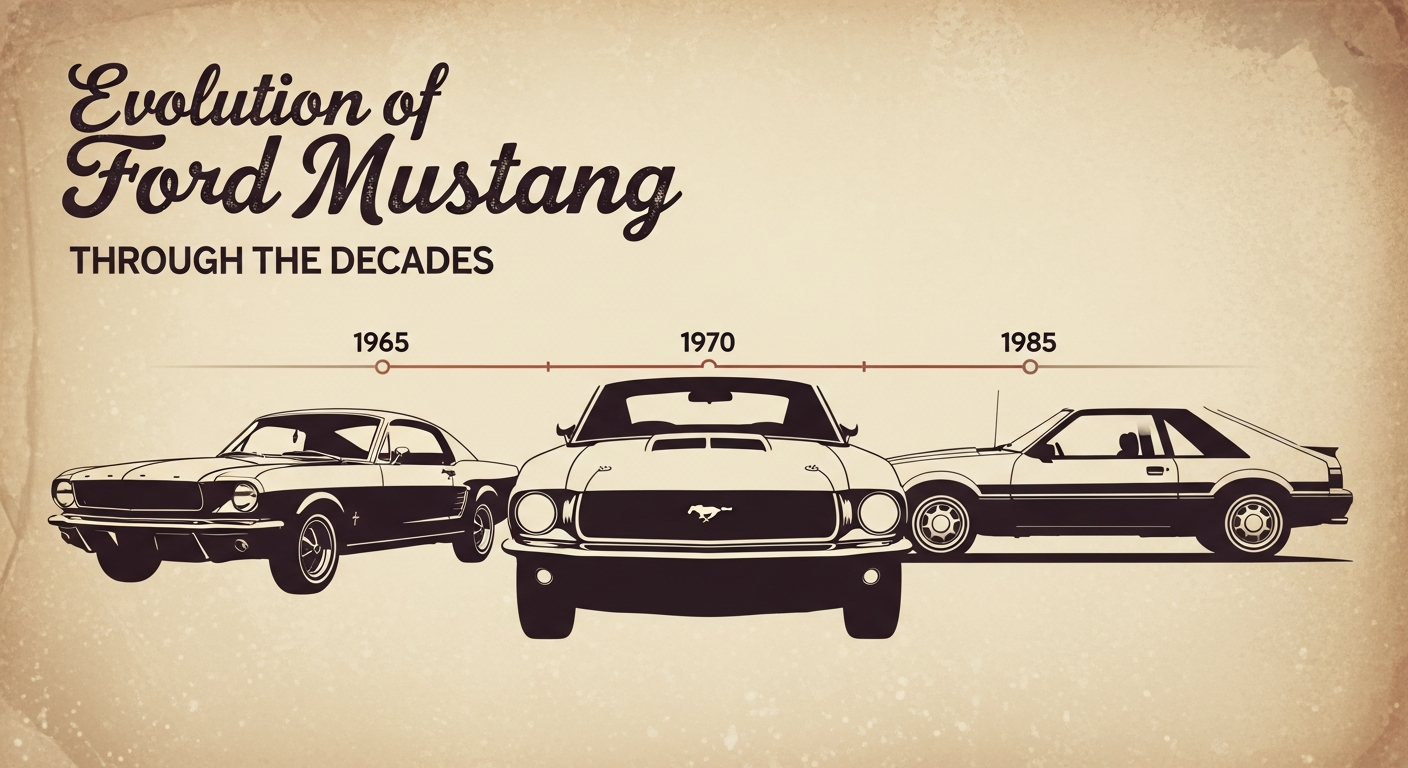
If there is one vehicle that has shaped American automotive history, it is the Ford Mustang. For over six decades, this name has stood for freedom, performance, and the American dream on four wheels. Let us take a journey through time through the fascinating evolution of an automobile that changed the world.
1964-1973: The Birth of an Icon
On April 17, 1964, Ford unveiled a car at the New York World's Fair that would revolutionize the automotive world. The first Mustang was not a technical revolution. It was based on the platform of the modest Ford Falcon. But what Lee Iacocca and his team created was a marketing masterpiece: an affordable, sporty car for the masses.
The success was unprecedented. In the first 100 days, Ford sold over 100,000 Mustangs. After one year, it was already 680,000. A record that still stands today. What made the first Mustang so special? It was the combination of sporty design, extensive customization options, and an unbeatable value proposition.
Pony Car Born
The Mustang defined an entire vehicle class: the Pony Car
Something for Everyone
From six-cylinders to Big-Block V8s. Options for all
Sales Records
680,000 units in the first year. unmatched
The years 1967-1970 marked the pinnacle of the first generation. The muscle car era was in full swing, and Ford responded with high-performance models like the Shelby GT350, GT500, Boss 302, and the legendary Boss 429. These models are now sought-after collector's items whose values regularly reach six-figure sums.
1974-1978: Mustang II. Adapting to New Realities
The 1973 oil crisis changed everything. The era of large, thirsty V8 engines seemed over. Ford responded with the Mustang II. A completely redesigned, more compact vehicle. Built on the Pinto platform, the Mustang II was smaller, lighter, and more economical than its predecessor.
Enthusiasts were shocked. Where was the V8? Where was the muscle car power? But from a historical perspective, the Mustang II was exactly the right car at the right time. It secured the survival of the brand in difficult times and sold surprisingly well. Over 385,000 units in 1974 alone.
1979-1993: The Fox-Body Era
With the Fox-Body Mustang, Ford returned to its roots. Built on the new Fox platform, this Mustang was lighter, more agile, and once again available with real V8 engines. The 5.0L V8 became synonymous with affordable performance in the 1980s and early 1990s.
Especially the 5.0L High Output V8 from 1982 onwards made the Mustang a serious performance car again. With the introduction of fuel injection in 1986, power rose to 225 hp. Impressive for its time and unmatched in this price class.
The Fox-Body era also produced legendary special models: the SVO with turbo four-cylinder, the SVT Cobra, and numerous limited editions. This generation laid the foundation for the modern tuning scene and remains popular with modifiers to this day.
1994-2004: Retro Design Meets Modern
The SN-95 Mustang brought retro-inspired design back for the first time. The styling was reminiscent of the 1960s classics, while modern technology worked under the hood. The new modular 4.6L V8 replaced the proven 5.0L. Initially with a modest 215 hp, later significantly more powerful.
The pinnacle of this generation was the 2003-2004 SVT Cobra: a supercharged 4.6L V8 with 390 hp, independent rear suspension, and state-of-the-art technology. This Cobra was faster than many exotics of its time and cost only a fraction of the price.
2005-2014: Return to the Roots
With the S197 Mustang, Ford celebrated its heritage like never before. The design was a clear homage to the first Mustangs, especially the 1967 Fastback. But under the retro body was state-of-the-art technology.
In 2011, Ford introduced the 5.0L Coyote V8. A completely new engine with 412 hp. This V8 became the benchmark for modern muscle car engines: powerful, rev-happy, efficient, and reliable. The Shelby GT500 of this generation offered a staggering 662 hp with its supercharged 5.8L V8. more than ever before in a street Mustang.
2015-Today: The Modern Era
The S550 Mustang was a revolution: for the first time, every Mustang received an independent rear suspension. The result? Significantly better handling, more comfort, and competitive lap times on the track. The Mustang was no longer just a straight-line rocket, but a fully-fledged sports car.
Technical highlights like adaptive magnetic dampers, electronic drift modes, digital displays, and over-the-air updates show how modern the Mustang has become. The current Shelby GT500 with 760 hp is the most powerful street car Ford has ever built.
With the Mustang Mach-E, Ford took the step into the electric future in 2020. Even though purists protested. The Mach-E shows that the Mustang name remains relevant in the 21st century.
Conclusion: 60 Years, One Legend
From an affordable Pony Car in 1964 to the technical marvel of today. The Mustang has continuously evolved without losing its identity. Each generation reflects its time: the muscle car era, the oil crisis, the tuner years, the retro wave, and now the electric future.
What remains constant? The fascination, the passion, and the feeling of freedom that every Mustang conveys. At Gatran Garage, we have restored, maintained, and optimized every generation. Whether you're looking for a classic '67 Fastback or want to tune your modern GT500. Our expertise spans 60 years of Mustang history.