
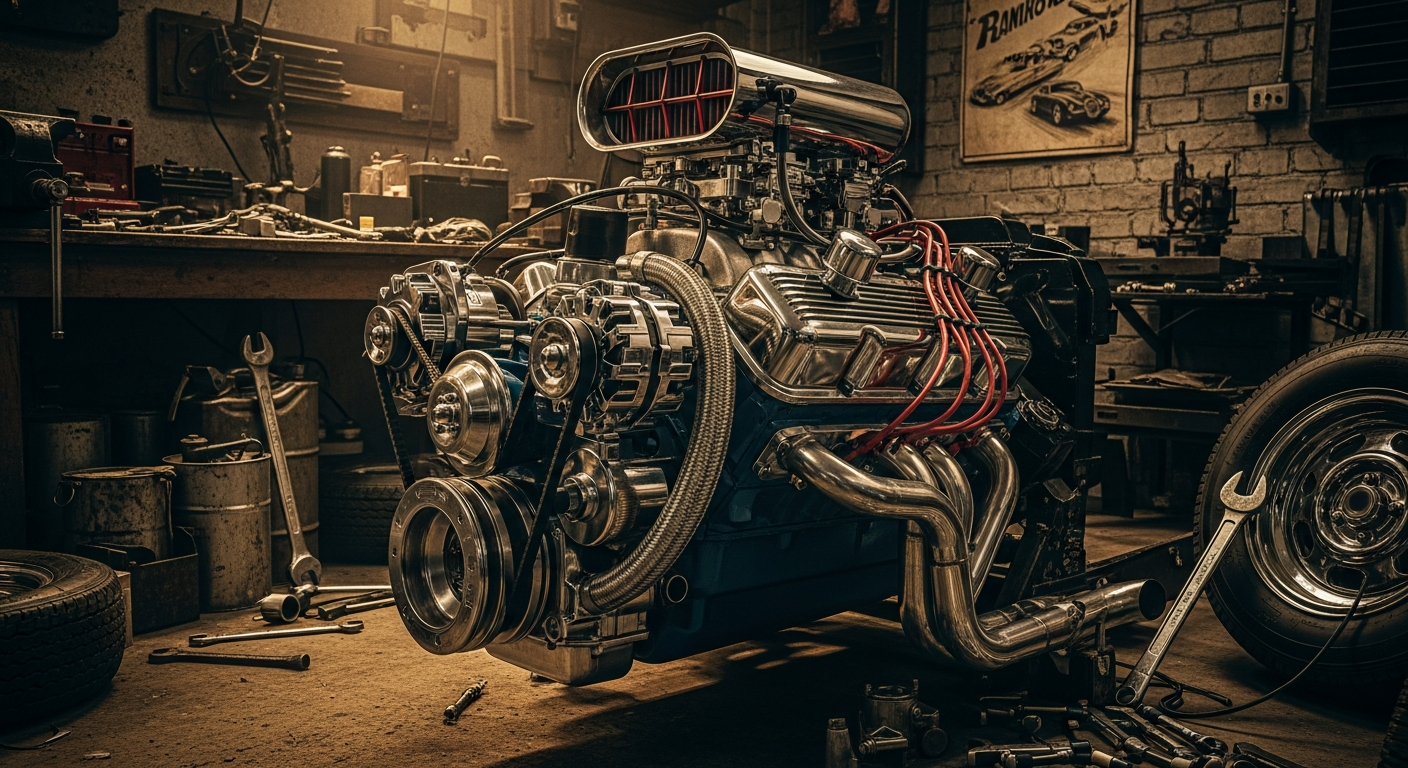
When you think of American vehicles, certain images immediately come to mind: massive V8 engines, mile-long hoods, endless chrome, and a sound that resonates through your entire body. But what truly makes US cars special? Let's go beyond the clichés and explore the unique characteristics of American automobiles.
The Philosophy: Bigger is Better
The American automotive philosophy differs fundamentally from the European approach. While Europe emphasizes efficiency, precision, and handling, a different mindset dominates in the USA: "There's no replacement for displacement". Nothing beats pure cubic inches.
This philosophy didn't emerge without reason. America is a land of vast distances, endless highways, and historically low gas prices. A large engine with abundant torque provides relaxed cruising over long distances without the engine constantly revving high. The result? Comfort and smoothness, even at 75 mph on the Interstate.
Displacement Giants
While European sports cars shine with 2.0L turbo engines, US cars have always relied on displacement: 5.0L, 6.2L, 7.0L or more are not uncommon.
The Sound
The characteristic V8 rumble is unmistakable. This sound isn't just loud. It's part of the DNA of American automobiles.
V8 Engines: The Heart of American Cars
The V8 engine is the ultimate symbol of American automobiles. But why specifically V8? Why not six-cylinders like many European sports cars or turbocharged four-cylinders like modern vehicles?
The answer lies in history and engineering philosophy. A V8 offers a perfect balance of power, torque, and refinement. The 90-degree V-configuration allows for compact construction with high displacement. Additionally, a V8 produces a unique, smooth sound through its firing order.
Classic examples include the Chevrolet Small-Block V8 (since 1955), the Ford Windsor V8, or the legendary Chrysler Hemi. These engines were produced for decades, constantly refined, and are now icons of automotive history.
Big-Block vs. Small-Block
Another distinctive feature of American engines is the distinction between Small-Block and Big-Block V8 engines:
- Small-Block: More compact design, typically 4.3L to 5.7L displacement. Example: Chevrolet 350 (5.7L). One of the most produced V8 engines of all time.
- Big-Block: Larger, more massive construction, typically 6.5L to 7.4L or more. Example: Chevrolet 454 (7.4L). A monster of torque and power.
Interestingly, a Big-Block in the 1960s often didn't produce dramatically more power than a Small-Block. The advantage lay in massive torque at low RPMs. perfect for acceleration from a standstill and relaxed cruising.
Design: Form Follows Function (Sometimes)
American cars from the postwar era through the 1970s were characterized by extravagant design. Massive tail fins, mile-long hoods, two-tone paint schemes, and chrome wherever the eye could see.
A 1959 Cadillac with its dramatic fins wasn't simply a car. It was a rolling statement. These design excesses reflected the optimism and prosperity of postwar America.
But practical considerations also played a role: The long hoods provided space for the large V8 engines, the wide bodies offered comfort for up to six people on a continuous bench seat. American cars were touring vehicles for a land of continental dimensions.
Muscle Cars: The Ultimate Distinction
The Muscle Car era (approx. 1964-1974) perhaps represents the most unique phase of American automotive history. The concept was simple and brilliant: Take a mid-sized, affordable car and install the biggest, most powerful engine possible.
The results were legends like the Pontiac GTO, Chevrolet Chevelle SS, Dodge Charger, Plymouth Road Runner, and of course the Ford Mustang. These cars offered V8 power for everyone. Not just millionaires.
A 1970 Chevelle SS 454 with its 7.4L V8 and 450 HP cost about $3,500 new. Today, a comparable car (if one existed) would cost at least ten times as much. And there would be no modern equivalent for the raw, unfiltered power of these Muscle Cars.
Technical Features
Solid Axle vs. Independent Suspension
Many classic American cars, especially Muscle Cars, used a solid axle (Live Axle) in the rear instead of independent suspension. This may sound primitive, but it had advantages:
- Robustness: Simple construction, less prone to problems
- Dragstrip Performance: Better traction when accelerating from a standstill
- Ease of Maintenance: Easier to repair and modify
Automatic Transmissions Dominate
While manual transmissions were traditionally preferred in Europe, the automatic transmission dominated in the USA early on. By the 1950s, an automatic was standard in many American cars.
The reason? Comfort while cruising. On long highway drives, an automatic is more relaxed. Additionally, American V8 engines had so much torque that they accelerated confidently even with a three-speed automatic (the standard at the time).
The Culture: More Than Just Cars
US vehicles are closely intertwined with American culture. The car represents freedom, individuality, and the American Dream. Cruising on Route 66, drive-in theaters, hot rod culture, drag racing. All of this is inseparable from American automobiles.
This culture has been exported to Europe. At Gatran Garage, we experience at our annual US Car Meets how people from all over Southern Germany come together to celebrate this American automotive culture. It's not just about the cars themselves, but about the lifestyle they convey.
Conclusion: Uniquely American
US vehicles are different. And that's exactly what makes them special. Large engines, distinctive design, relaxed driving style, and a culture all their own. They don't follow European conventions, but their own logic.
Whether you're seeking the raw power of a Muscle Car, the luxury of a classic Cadillac limousine, or cruising in a '67 Mustang Convertible. American cars offer a driving experience that can't be found anywhere else. And at Gatran Garage, we've understood and lived these unique qualities for over 30 years.