
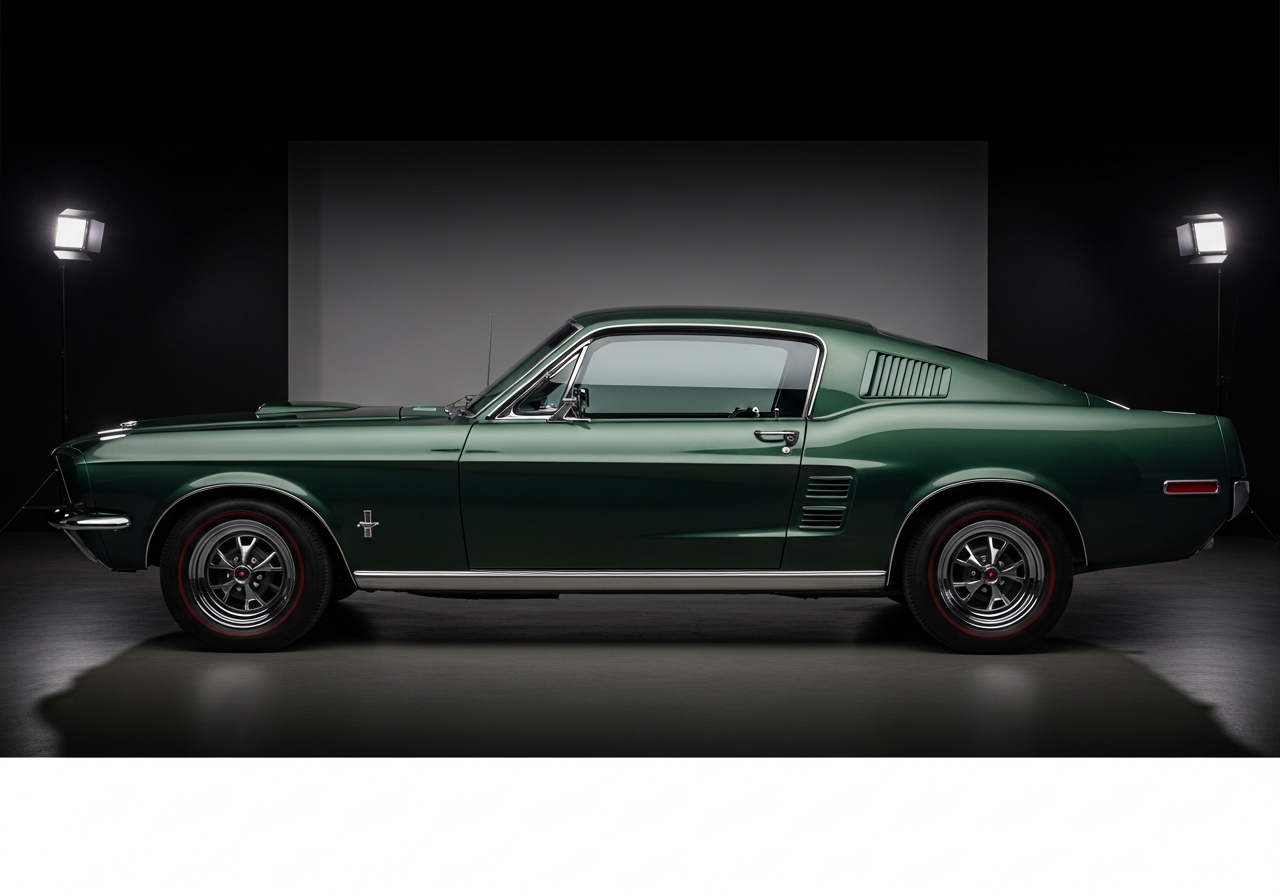
Since 1967, Chevrolet and Ford have been fighting the same battle — on the drag strip, at the traffic lights, and now in the German collector market. Camaro vs. Mustang is not just a question of taste. It is a question of history, driving character, parts availability, value development and life situation. At Gatran Garage we have restored hundreds of both — here is our honest comparison.
Born as Rivals: The History
The Ford Mustang launched in April 1964 and created an entirely new car category: the pony car. In its first year alone, Ford sold over 400,000 units — a record that shook Detroit. Chevrolet was caught off-guard. The answer came in 1966: the Chevrolet Camaro, introduced for the 1967 model year, was built on one mission — to beat the Mustang. From day one, the rivalry was intentional, personal and total.
Chevrolet Camaro
- Born 1967, direct Mustang answer
- 5 generations to 2024
- Legendary: SS, Z/28, COPO, Yenko
- Discontinued 2024 — now collectible
Ford Mustang
- Born April 1964, created the pony car
- 6 generations, still in production
- Legends: Shelby GT350/500, Boss, Mach 1
- Most popular US car in Germany
Performance: Numbers Don't Lie
Both cars were available in wildly different configurations — from docile six-cylinders to fire-breathing race engines. Here we focus on the V8 variants that collectors care about.
| Criterion | Camaro | Mustang |
|---|---|---|
| Engine (Top V8) | 7.0L LS7, 505 PS (Z28 2007) | 5.8L Trinity, 664 PS (GT500 2013) |
| Classic V8 (1969) | 350ci / 300 PS | 428ci / 335 PS |
| Weight (1969) | 1.530 kg | 1.470 kg |
| Spare parts Germany | Good — many suppliers | Excellent — most popular |
| H-plate at 30 years | Yes, 1994 and older | Yes, 1994 and older |
| Entry price Germany | ab 15.000 € | ab 18.000 € |
| Community Germany | Large, active | Very large, events nationwide |
Driving Character: Two Philosophies
Camaro
The Camaro was engineered to be the better driver's car. The chassis sits lower, the suspension is tauter, the body is stiffer. The Camaro Z/28 was homologated for Trans-Am racing — it shows. On a winding road, the Camaro rewards driver skill. The steering is more direct, the handling more neutral. It is the choice of people who drive, not just sit.
Mustang
The Mustang is more relaxed, more accessible — and that is not a weakness. It was designed for America's long highways: comfortable, powerful, iconic. The classic front suspension with twin A-arms gives a soft, rolling feel that suits long-distance driving. Later Mustangs (1979+ Fox body, 1994+ SN95) are more sorted dynamically. But the old Mustang is happiest in a straight line, V8 singing.
Reality in Germany: TÜV, H-Plate & Parts
Both cars are excellent choices for German collectors — but there are practical differences worth knowing before you buy.
Parts availability
Mustang +Good through US specialists. Body panels, engine parts, interiors are well stocked. Rare COPO and Yenko parts require direct USA sourcing.
Excellent — the broadest parts support of any US car in Germany. Three dedicated Mustang importers operate nationally, and common parts are stocked locally.
H-plate (Historisches Kennzeichen)
EqualFrom 30 years old and original condition: €191 flat vehicle tax per year, free from environmental zone bans — same process as Mustang.
Same as Camaro: 30+ years, TÜV Oldtimer assessment, largely original. Many workshops in Germany are experienced with Mustang H-plate preparation.
Purchase price Germany
Camaro +Entry from ~€15,000 for a project car. A solid driver-quality 1969 Camaro SS runs €35,000–55,000. Z/28 and COPO Camaros: €80,000–200,000+.
Entry from ~€18,000. A solid 1969 Mustang fastback runs €40,000–65,000. Shelby GT350/GT500: €120,000–350,000+. Boss 429: €150,000+.
Value development
Mustang +Strong but narrower market. Early first-gen Camaros (1967–69) and performance variants appreciate well. Production numbers were lower than Mustang, which helps rarity.
Broadest liquid market of any American classic. High-option Mustangs consistently outperform other muscle cars at auction. Easier to buy and sell in Germany.
Which One is Right for You?
Choose the Camaro if...
- You want the sharper driver's car with more chassis feedback
- You value exclusivity — fewer Camaros on German roads
- You want to enter at a slightly lower price point
- You are drawn to GM's small-block sound and engineering
- You want a car that finished production in 2024 — rarity will increase
Choose the Mustang if...
- You want the most iconic American car with universal recognition
- You value the best parts support and service network in Germany
- You plan to sell or upgrade — it is the most liquid classic car market
- You want to attend events — the Mustang community in Germany is massive
- You prefer the long-distance, highway-cruiser character
Our Honest Answer After Hundreds of Restorations
At Gatran Garage, we have restored Camaros and Mustangs in equal numbers over 30 years. If someone asks us which to buy — we ask them back: what do you want to feel when you open the garage door? The Camaro driver feels like a racer. The Mustang driver feels like an icon. Both feelings are valid. Both cars are extraordinary.
The only wrong choice is waiting. Both are getting rarer, both are getting more expensive. Buy the one that makes your heart beat faster — then let us make it perfect.
Frequently Asked Questions
Which is better for daily use in Germany — Camaro or Mustang?
Both are challenging as daily drivers due to their size and fuel consumption. The Mustang has an edge in parts availability and service network in Germany. If you want a car for regular weekend drives and events, both work well — the Mustang is simply easier to service at many workshops.
Which holds its value better in Germany?
Classic Mustangs (1964–1973, especially Mach 1, Boss 302/429, Shelby variants) have historically shown the strongest value growth in Germany. Early Camaros (1967–1969 Z/28 or SS) are close behind. Matching numbers, factory documentation and professional restoration are the key value drivers for both.
Are spare parts for the Camaro easy to find in Germany?
Yes — both Camaro and Mustang are well supported by European import specialists. For the Mustang, the supply is slightly broader because it is the most popular US car in Germany. For rare Camaro variants like the Z/28 or COPO, sourcing specific engine components may take longer.
Which is easier to get an H-plate for in Germany?
Both are equally straightforward for the H-plate process. The vehicle must be at least 30 years old and pass a TÜV Oldtimer assessment. We prepare both Camaros and Mustangs for H-plate — the process is the same. Key: the car must be in a condition that largely corresponds to its original state.
Camaro or Mustang — which sounds better?
Pure subjective opinion — but here is the technical view: the Camaro's small-block Chevy (350/396/454) has a deeper, rougher idle. The Mustang's 289/302/351/428 sounds slightly higher and more crisp. Both are unmistakably V8 American. At Gatran Garage, we have restored both — the sound difference is real, but equally impressive.
Further Reading
Restoration Services
Frame-off, bodywork, engine & paint for Camaro and Mustang
US Cars as Investment 2026
Which models gain most value — Mustang, Corvette, Camaro & Charger
Evolution of the Mustang
All generations of the Ford Mustang from 1964 to today
Winter Storage from €199/month
Secure, climate-controlled storage for your Camaro or Mustang