
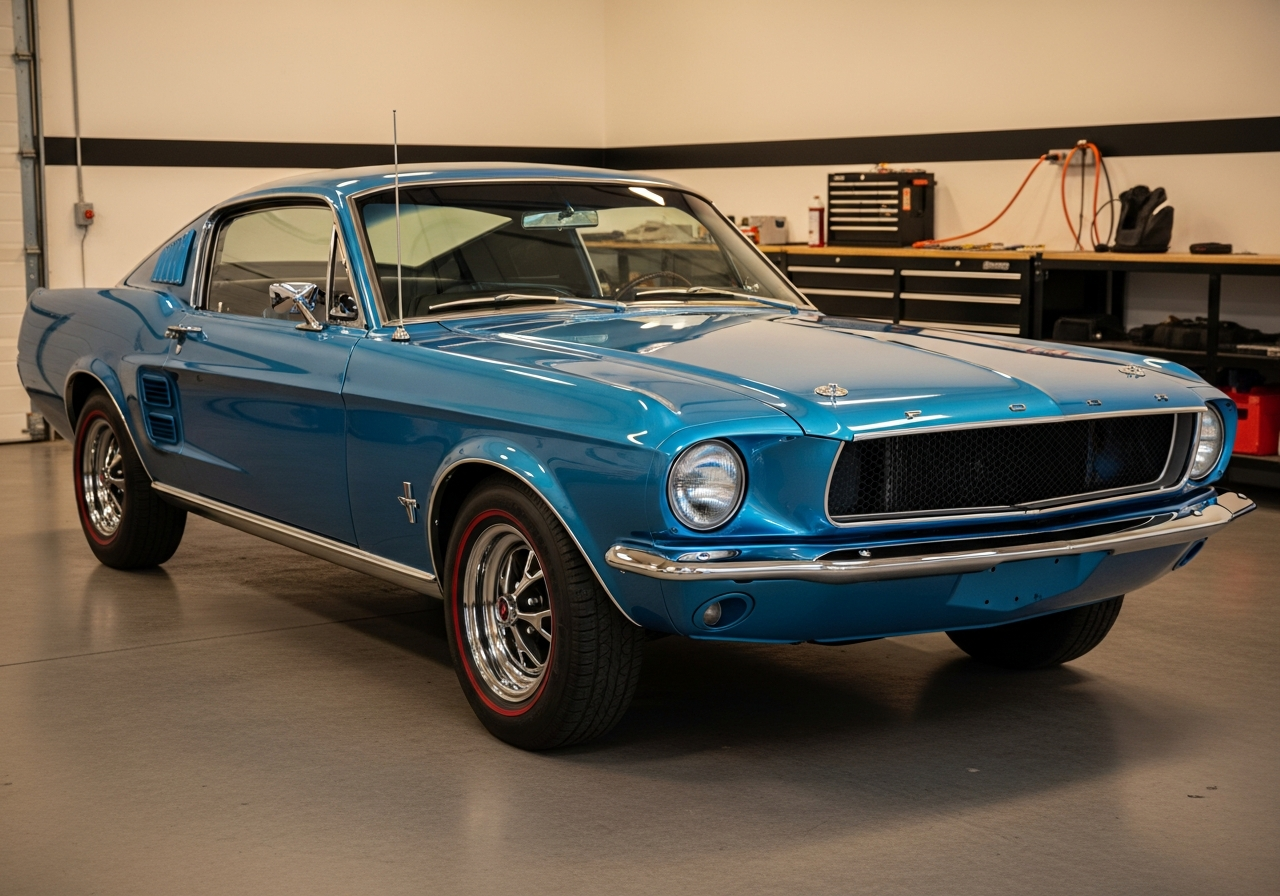
A 1969 Chevrolet Camaro Z/28 bought for €28,000 in 2015. Sold in early 2025 for €74,000. A 1967 Ford Mustang Shelby GT500 that changed hands at €45,000 in 2012 and recently appraised at €160,000. A Corvette C2 Stingray Split-Window purchased from an estate for €62,000 in 2018, now valued at over €140,000. These are not exceptional cases or lucky finds. They represent a consistent pattern that has played out across the classic US car market over the past decade — and that market analysts and auction houses expect to continue into 2026 and beyond. Classic American muscle cars have crossed a threshold: they are no longer purely passion objects. For a growing number of buyers and holders, they are a deliberate asset class with measurable, documented returns.
The market context: why classic US cars outperform
The Hiscox Classic Car Index — the most widely referenced benchmark for collector car performance — showed that classic cars as an asset class outperformed the FTSE 100 over the ten-year period from 2012 to 2022, returning an average of 193% versus 59% for equities. Within that category, American muscle cars consistently ranked among the top-performing segments, alongside blue-chip European sports cars like Ferrari and Porsche 911.
What drives this? Several structural factors distinguish classic US cars from other investments. First, the supply is fixed and declining. Every year, more examples are damaged beyond repair, destroyed or permanently withdrawn from the market into long-term collections. A 1970 Dodge Challenger R/T 440 Six Pack cannot be reproduced. Second, the buyer demographic is expanding, not contracting. Baby boomers who grew up in the muscle car era — and who now have significant disposable wealth — continue to drive demand at auction. At the same time, a younger generation of enthusiasts is entering the market, particularly for late-60s and early-70s models that have reached the 50-year nostalgia milestone. Third, classic US cars in Germany benefit from the H-Kennzeichen (historic vehicle) registration system, which provides meaningful tax and insurance advantages that further reduce the cost of ownership.
The post-pandemic period introduced significant volatility — sharp rises in 2021–2022 followed by a correction in 2023 as interest rates rose globally. But 2024 and early 2025 have shown renewed strength, particularly for the highest-quality, most original examples. The correction effectively filtered out speculative buyers, leaving a market dominated by genuine enthusiasts and informed investors — a healthier, more sustainable foundation.
The strongest value models in 2026 — and what drives their prices
Not all classic US cars appreciate equally. The difference between a strong investment and a disappointing one often comes down to the specific model, year, body style and configuration. Here is how the main segments break down for 2026, based on auction results, dealer transactions and appraisal data:
Ford Mustang (1964½–1973)
+8–15% p.a.The Mustang is the most liquid classic US car market in the world. Demand is global, supply of original examples is finite and the model's cultural significance is undisputed. The strongest appreciation is concentrated in specific variants: Shelby GT350 and GT500 models command premiums of 300–500% over comparable base Fastbacks. Big-block cars — particularly 390 GT and 428 Cobra Jet variants — have seen consistent appreciation. Among regular production Mustangs, 1969–1970 Boss 302 and Boss 429 models are the current hot spots, with Boss 429s regularly crossing €200,000 at major auctions for documented, numbers-matching examples. Standard Fastbacks from 1965–1968 in good condition represent the entry point — more accessible pricing but lower percentage appreciation than the blue-chip variants.
Chevrolet Corvette C2 Stingray (1963–1967)
+10–18% p.a.The C2 Stingray is the most consistently appreciating US car segment of the past decade. The Split-Window Coupe of 1963 — produced for only one model year — is now in a league of its own, with genuine matching-numbers examples in concours condition achieving over €400,000 at Mecum, Barrett-Jackson and RM Sotheby's. Convertibles and post-1963 Coupes with high-performance options — the 396 and 427 big block cars, Rochester fuel injection units — are the next tier. Even base 327 small-block C2s in driver condition have appreciated substantially, making the C2 one of the few segments where all variants show positive long-term trends.
Dodge Charger / Challenger (1968–1971)
+7–12% p.a.B-body Mopars have the most dramatic price spread of any US car segment. At the top end, a genuine 1970 Dodge Challenger R/T 426 HEMI convertible — one of only 9 produced — is essentially priceless, with the handful of known examples never appearing on the public market. More practically relevant: Charger R/T and Challenger R/T models with 440 and 440 Six Pack engines in documented original condition have been consistently strong, with good examples now well into six figures. The challenge with Mopars is provenance — more 'clones' (regular Chargers converted to R/T specification) exist in this segment than in almost any other, making documentation and VIN verification critical.
Chevrolet Camaro Z/28 und SS (1967–1969)
+6–10% p.a.First-generation Camaros (1967–1969) continue to be among the most desirable muscle cars. Z/28 variants — produced specifically for Trans-Am racing with the 302 cubic inch small-block — are the most prized and have seen the most consistent appreciation. Correct DZ 302 engine cars with documentation are now regularly €80,000–€120,000 at auction. COPO Camaros (Central Office Production Order cars with 427 big blocks and ZL1 aluminium engines) are in a category with the rarest Mopar variants — absolute rarity guarantees continued appreciation regardless of market conditions.
Chevrolet Bel Air / Nomad (1955–1957)
+5–9% p.a.The Tri-Five Chevrolets (1955, 1956, 1957) represent the archetype of American 1950s styling and remain deeply desirable globally. The 1957 Bel Air in particular has a near-universal recognition factor that drives demand beyond the traditional muscle car collector base. Convertibles and the rare Nomad station wagon body styles carry significant premiums. Original V8 cars — particularly 283 fuelie units — are substantially more valuable than six-cylinder equivalents. The 1957 market showed particular strength in 2024, with top convertibles in show condition achieving €150,000–€200,000 at major auctions.
The five decisive value drivers — what separates a €30,000 car from a €130,000 car
Two identical-looking 1969 Ford Mustang Fastbacks can differ in value by a factor of four. The difference lies not in what you see, but in what you can prove. Here are the factors that drive value at the highest levels of the classic US car market:
Matching Numbers — the single most important factor
Matching numbers means that the engine, transmission and rear axle carry stampings that correspond to the vehicle's body — documented through the Marti Report (Ford), Protect-O-Plate (Chevrolet) or broadcast sheet (Mopar/GM). A matching-numbers car is worth typically 40–80% more than an identical-specification car with a replacement engine. This premium exists because matching numbers is the single most difficult thing to fake convincingly — and because it represents the closest thing to the car's original, untouched factory specification. At Gatran Garage we verify matching numbers on every vehicle we appraise for purchase or restoration — it is the first question we ask and the first thing we check.
Documented history — provenance matters more than ever
A car with a known ownership chain — original window sticker, build sheet, title history, service records — commands a premium over an identical car with an unknown history. In the current market, where the number of genuinely original, well-documented examples is declining, provenance documentation is an increasingly significant value driver. This includes the Marti Report (for Fords), Protect-O-Plate (for Chevrolets, documented original warranty card), broadcast sheets and tank stickers (Mopar), original dealer invoices and order forms. If you are buying a classic US car as an investment, acquiring the vehicle's documentation — even retroactively through research and title searches — adds tangible value.
Factory options and RPO codes — the right factory order
The specific options a car left the factory with determine its value ceiling far more than cosmetic condition. A 1969 Camaro with factory documentation showing the Z/28 package, 4-speed close-ratio gearbox, Posi-Traction rear and factory AC is worth dramatically more than a Z/28 with the basic drivetrain options. For Fords, the Marti Report decodes every factory option — engine, transmission, body colour, interior, dealer-installed options. For GM cars, the broadcast sheet (often found taped under carpet or seat cushions) is the key document. Rare factory option combinations — particularly high-performance engine plus rare body colour plus manual transmission — create significant value premiums that only increase with time as examples are lost or modified.
Restoration quality — done right or done wrong
A professionally executed, period-correct restoration adds substantial value. A poorly done restoration — mismatched paint codes, incorrect replacement parts, unauthorised modifications — can reduce a car's value below what it would achieve as an honest, unrestored driver. The highest values are achieved by two categories: genuinely original, unrestored cars in preservation condition (barn finds that survived intact) and professionally restored cars with documented, concours-quality work. The middle ground — amateur restorations with incorrect parts and approximate colour matching — sits below both. If you are restoring a classic US car for investment, use the correct GM, Ford or Chrysler colour codes, source correct NOS (New Old Stock) or quality reproduction parts, and have all machine work done by specialists with experience in American V8 engines. Document every step with photographs and receipts.
Professional storage — protecting the investment year-round
A classic US car stored improperly for five years can lose more value than a decade of appreciation gains. Humidity causes internal rust on engine bores and brake cylinders. Flat spots develop on tyres. Rodents damage wiring and upholstery. UV exposure bleaches paint and fades interiors. For a car that represents a significant financial asset, climate-controlled professional storage is not a luxury — it is a necessary cost of protecting the investment. At Gatran Garage, our storage facility maintains controlled temperature and humidity year-round, with regular engine start-ups, tyre pressure checks and security monitoring. The annual cost of professional storage is typically 1–2% of the car's value — far less than the cost of repairing the damage that improper storage causes.
Practical guidance: how to buy a classic US car as an investment
The classic US car market has become sophisticated enough that buying blind — without expert inspection — is genuinely risky at any price point above €20,000. Here is how we guide buyers who come to us for advice at Gatran Garage:
Always obtain a Marti Report or equivalent
For Ford vehicles, the Marti Report is the gold standard — it decodes the complete factory specification from Ford's production database for around $50 US. For GM cars, the broadcast sheet or a Chevrolet/Pontiac decoder. For Mopar, a Chrysler broadcast sheet and fender tag decode. No reputable seller should refuse a VIN-based documentation request.
Pre-purchase inspection by a specialist
A pre-purchase inspection by a workshop specialised in classic US cars costs €200–400 but can save you from a €10,000–€50,000 mistake. The inspection should cover engine stampings, chassis stampings, body panel originality (original vs. replacement panels via magnet test), evidence of previous accident damage, rust condition and mechanical state.
Be wary of tributes and clones
The classic US car market has a significant problem with vehicles that have been upgraded ('cloned') to resemble higher-value variants. A standard Charger fitted with R/T badging. A base Camaro rebuilt to Z/28 specification with a replacement engine. These vehicles are worth a fraction of the genuine article and are sometimes sold by sellers who are themselves unaware of their car's actual provenance. Decoding the VIN and checking the data plate against the documented specification is essential.
Buy the best you can afford, not the cheapest
In the classic US car investment market, quality compounds. A top-condition, well-documented example in a strong segment appreciates faster and holds its value better through market corrections than a mediocre example in the same segment. The money saved buying a cheaper example is usually spent on maintenance, incorrect parts and lower resale values. The premium for genuinely excellent condition narrows at the top of the market cycle — but always exists.
Conclusion: passion and investment are not mutually exclusive
The strongest classic US car investments we have seen at Gatran Garage share a common characteristic: the owner bought what they genuinely loved, maintained it properly, documented everything and stored it correctly. Buying purely for investment — without passion for the vehicle — tends to lead to under-maintained cars, poor storage decisions and premature sales at the wrong point in the market cycle. The combination of genuine enthusiasm and investment discipline is what produces the best long-term results. A Mustang or Corvette that you also enjoy is not a lesser investment than one you never drive — it is a better-maintained, better-understood asset.